
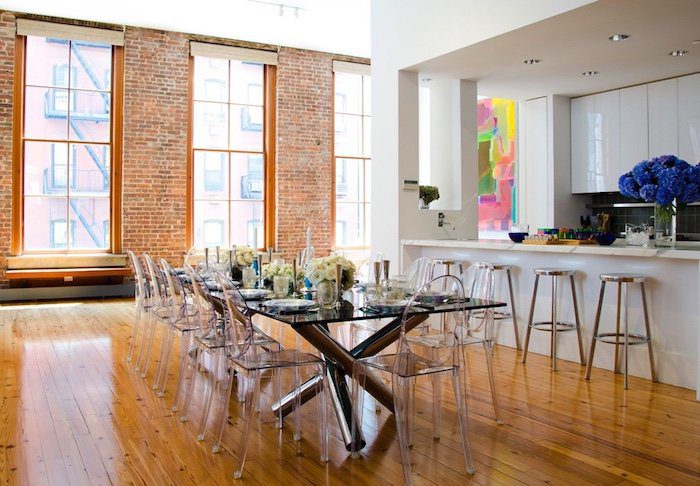
So you’re trying to figure out what dining table makes sense for your space.
Maybe you live in a condo where your dining area doubles as your work-from-home zone. Or maybe you’ve got that classic open floor plan where the dining room isn’t really a separate room at all—it just kind of flows into the kitchen and living area.
I get it. Most of us don’t have the luxury of a formal dining room that only gets used twice a year for thanksgiving and christmas.
We need furniture that works hard, looks good, and doesn’t make our already tight spaces feel even more cramped.
That’s where acrylic comes in.
Now, I know what some of you are thinking. Acrylic? Isn’t that just plastic? Well, yes and no. Clear Acrylic (aka lucite or perspex) Dining Room Tables meet these demands through a mix of visual lightness and structural reliability.
They’ve been showing up in design magazines and celebrity homes for years now, and there’s a really good reason why.
I’ve been writing about interior design for over 15 years.
I’ve toured homes, interviewed designers, and honestly made my share of furniture mistakes in my own place.
What I’ve learned is that the best furniture isn’t always the most expensive or the most traditional.
Sometimes the smartest choice is the one that solves multiple problems at once.
Let’s talk about why acrylic tables might be exactly what your multi-use dining space needs.
How Acrylic Is A Smart Pick For Multi-Use Dining Space
Visual Lightness Makes Small or Busy Spaces Feel Bigger
Here’s the thing about solid wood or dark tables.
They’re beautiful, don’t get me wrong. But they take up visual space.
Your eye hits that big rectangular mass and registers it as an obstacle. In a international apartment or a multi-purpose room, that can make everything feel closed in.
Acrylic basically disappears.
I mean, it’s there. It’s holding your dinner plates and your laptop and whatever else you pile on it.
But because you can see through it, your eye travels past the table to the floor, the rug, the wall beyond. That continuous sightline makes the whole room feel more open.
I saw this firsthand when I visited a designer’s brooklyn loft a few years ago. She had maybe 600 square feet total.
Her dining area was squeezed between the kitchen counter and the small living room sofa. But she’d chosen this gorgeous acrylic table with a simple pedestal base.
When you walked in, you didn’t immediately think “wow, this place is tiny.” Your eye moved through the space. It felt breathable.
This matters even more if your dining area shares space with other functions. Maybe you’ve got your dining table near your entryway. Or maybe it’s right where people walk through to get to the bedroom.
A heavy table in those spots creates a visual barrier. Acrylic lets the space flow.
The transparency also means you can see your area rug completely. If you invested in a really beautiful rug—and you should, by the way—why cover it up with table legs and a thick tabletop? With acrylic, the rug becomes part of the design instead of getting hidden.
Some people worry that a clear table will look too cold or too modern. But actually, it’s pretty neutral. It takes on the character of whatever you put around it.
Pair it with warm wood chairs and it feels organic. Use metal chairs and it leans industrial. Upholstered chairs? Now it’s soft and elegant.
Easy to Move, Rearrange, and Reconfigure
Multi-use spaces need flexibility. That’s just the reality of how we live now.
Acrylic is light. I’m talking really light compared to wood or marble table or glass.
A solid wood dining table can easily weigh 150 pounds or more.
Good luck moving that around by yourself when you need to vacuum or when you’re hosting a party and need to create more floor space.
Acrylic tables? You can usually move them with one person.
I’m not saying they’re feather-light, but they’re manageable. This is huge if you’re someone who likes to rearrange furniture seasonally or if your space needs to transform quickly.
I remember interviewing an event planner who worked from home.
She had this beautiful acrylic dining table that she could push against the wall when she needed to photograph products for clients.
Then she’d pull it back to the center for family dinners. Try doing that with a 200-pound farmhouse table.
And here’s something I didn’t expect until someone pointed it out to me.
When you can move your furniture easily, you’re more likely to actually clean properly.
You know how dust and crumbs accumulate under and around a heavy table that you never move? Yeah. Being able to shift your table out of the way means you’ll actually do it.
There’s also the initial setup to consider.
If you live in a building with stairs or a narrow hallway, getting a massive dining table into your apartment can be… Well, it can be a nightmare.
I’ve heard stories of people who had to return tables because they literally couldn’t fit them through the door.
Acrylic tables are easier to maneuver during delivery and setup.
Durable Enough for Daily Use Without Looking Heavy
People assume acrylic is fragile. I get that. It looks delicate. But good quality acrylic—we’re talking solid pieces, not thin sheets—is really tough.
Acrylic doesn’t chip like wood. It doesn’t scratch as easily as glass.
It won’t stain the way marble can. If you’ve got kids who are doing art projects on the table, or if you’re eating takeout straight from the container while watching netflix, acrylic can handle it.
I’m not saying it’s indestructible. You can scratch acrylic if you really try.
Dragging something sharp across it isn’t great. But for normal daily use—plates, cups, laptops, mail, keys, whatever you dump on your dining table—it holds up well.
And when it does get minor scratches, you can actually buff them out.
There are polishing kits made for acrylic. Try doing that with a scratched wood table.
You’re looking at sanding and refinishing, which is a whole project.
The other durability factor is that acrylic doesn’t warp or crack from humidity changes.
Wood expands and contracts with moisture. Glass can chip. Acrylic? It stays stable.
This matters if you live somewhere with harsh winters or humid summers, or if your dining area is near a kitchen where steam and temperature changes happen constantly.
But here’s what I think is the biggest win. Acrylic gives you durability without visual weight.
You get a table that can handle real life without dominating your space. That’s pretty rare.
Usually you have to choose between delicate-looking furniture that you baby constantly, or chunky practical pieces that feel like they’re taking over the room.
Works with Any Interior Style Without Clashing
I’ve seen acrylic tables in minimalist scandinavian apartments, in maximalist boho spaces, in industrial lofts, in traditional homes with crown molding. They work everywhere.
Why? Because acrylic doesn’t have a strong style identity.
It doesn’t read as “modern” or “traditional” the way certain materials do. It’s a chameleon.
It adapts to whatever you put around it.
This is perfect for multi-use spaces because those areas usually need to blend with the rest of your home.
If your dining area opens directly into your living room, you don’t want a table that clashes with your sofa or your decor style. Acrylic quietly fits in.
I think about my friend who has this really eclectic style.
She’s got vintage persian rugs, mid-century modern chairs, contemporary art, and some traditional family heirloom pieces mixed in.
A wood table would have forced a style decision—what kind of wood? What finish? What era? She went with acrylic and it just works with everything. It doesn’t compete for attention.
The neutrality also means you can change your decor over time without needing to replace your table. Maybe right now you’re into warm neutrals and natural textures.
In two years you might want jewel tones and velvet. Your acrylic table will work with both.
And if you’re in a rental where you can’t control the finishes—maybe you’ve got builder-grade oak cabinets that you hate but can’t replace—acrylic won’t add to the problem.
It won’t clash because it doesn’t really assert itself visually.
Some designers actually use acrylic pieces as a way to bridge different styles in a space.
If you’ve got elements that don’t quite go together, inserting something transparent in between can help the eye move more smoothly through the room.
Simple to Clean and Maintain for Multi-Purpose Living
Okay, let’s be practical here. If your dining table is where you eat breakfast, work on your laptop, help kids with school projects, fold laundry, and maybe do crafts on the weekend, you need something easy to clean.
Acrylic wins.
You wipe it down with a soft cloth and soapy water. That’s it. No special wood polish.
No worrying about water rings. No coasters required—though I still use them out of habit.
Spilled red wine? Wipe it up. Coffee rings? Gone. Marker from your kid’s art project? Comes off. The non-porous surface means nothing soaks in.
I will be honest about one thing though. Acrylic shows smudges and fingerprints.
If you have young kids who put their hands all over everything, you’ll notice. But here’s the thing—you’re wiping the table anyway after meals, right? It’s not extra work.
You just see the fingerprints more clearly than you would on wood.
Some people use a microfiber cloth to minimize streaks.
I’ve also heard of people using a tiny bit of glass cleaner, though you want to make sure it doesn’t have ammonia because that can dull the acrylic over time.
The maintenance thing really matters when your table serves multiple purposes.
If you’re moving from breakfast to work mode to dinner mode all in the same day, you need to be able to clean quickly between activities.
Spending ten minutes carefully cleaning and conditioning a wood table? Not happening in real life.
And because acrylic doesn’t require refinishing or special treatments, the long-term maintenance is basically zero.
No oiling, no waxing, no worrying about the finish wearing down in high-traffic areas.
Conclusion
Look, acrylic dining tables aren’t for everyone.
If you love the warmth and texture of natural wood, or if you inherited your grandmother’s antique dining set and it makes you happy, that’s great. Stick with what you love.
But if you’re working with a space that needs to be flexible, that feels a bit cramped, or that serves multiple purposes throughout the day, acrylic is worth considering.
What I’ve learned after writing about design for all these years is that the best choices aren’t always the obvious ones.
Sometimes the smartest solution is the one that gets out of your way and lets you live your life without constantly working around your furniture.
Acrylic does that. It gives you a functional surface without taking up visual space. It’s light enough to move when you need to.
It’s tough enough to use daily without stress. It works with whatever style you’ve got going on. And it cleans up in seconds so you can move on to the next thing.
Your dining area should make your life easier, not harder.
Especially if that area is pulling double or triple duty as an office, a homework zone, a craft table, or whatever else you need it to be.
The transparency thing might take a minute to get used to if you’re coming from traditional furniture.
But once you see how it opens up your space and gives you that flexibility you need, it’s hard to go back to heavy, opaque tables that anchor themselves in the room like they’re planning to stay forever.
Think about how you actually use your space.
If the answer involves multiple activities, frequent rearranging, or just wanting your room to feel less crowded, you know what to do.