
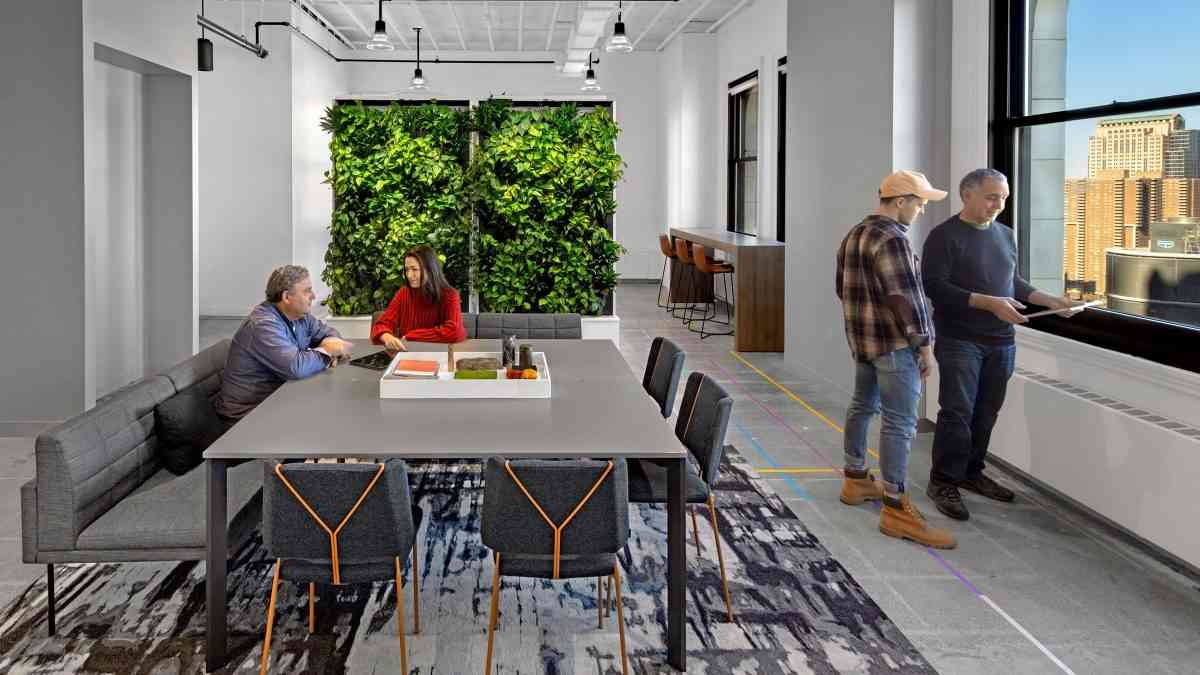
So here’s a question: how many hours do you spend in your office? Thirty-five, forty, maybe fifty hours a week? That’s more time than you spend in your bedroom, right? And yet most of us put more thought into picking out a sofa than we do about the space where we’re supposed to be doing our best work.
I’ve been writing about interiors for over fifteen years now, celebrity homes mostly, and I’ve walked through some incredible spaces. But the offices? That’s where it gets interesting. Because unlike someone’s living room where they can hide the mess before I arrive, offices tell the truth.
You can see it in people’s faces—the ones squinting under fluorescent lights, hunched over keyboards, wearing headphones just to think straight.
The thing is, we’ve known for years that office design matters. But somewhere between the cubicle era and the open-plan revolution, we forgot to ask the right questions.
It’s not about ping pong tables or nap pods or whatever the tech companies are doing now. It’s simpler than that, and harder too.
Your workspace is either helping your brain work, or it’s making everything harder than it needs to be.
Let’s talk about which is which.
Office Design Affects Focus And Employee Wellbeing
Natural Lighting and Its Impact on Concentration
Windows. Sounds basic, doesn’t it? But when’s the last time you actually sat near one at work?
There’s this study—Northwestern Medicine and University of Illinois, they looked at office workers—and the people who sat near windows got 46 minutes more sleep at night.
Forty-six minutes. Not because they were tired, but because their circadian rhythm wasn’t completely messed up from artificial light all day.
They also reported better sleep quality, more physical activity, better overall quality of life.
But here’s what gets me: we act like natural light is a luxury. Corner offices for executives, windowless conference rooms for everyone else.
The interns get the basement. And then we wonder why everyone’s tired by 2 PM, reaching for their third coffee, struggling to focus on a simple email.
Your eyes aren’t designed for this. Neither is your brain. Natural light tells your body what time it is, when to be alert, when to wind down.
Take that away and you’re basically asking your nervous system to guess. It’s going to guess wrong.
I visited an architecture firm once—ironic, I know—where they’d designed their own office with exactly zero consideration for daylight.
Beautiful space, terrible to work in. Three months in, they ripped out half the interior walls. Sometimes you have to learn the hard way.
Artificial lighting isn’t just “not as good” as natural light. It’s actively working against you.
Those overhead fluorescents? They flicker. Your eyes pick it up even when you don’t consciously notice.
Eye strain, headaches, fatigue. And the blue wavelength from screens combined with artificial light throws off your melatonin production, which is why you’re wired at midnight after a day in a windowless office.
What should you do? Get your desk near a window if you can. If you can’t, take breaks outside. Five minutes, ten minutes, just let your eyes see daylight and distance.
Your focus will come back faster than scrolling through your phone in the break room.
Noise Control and Acoustic Comfort
Open offices were supposed to save us, remember? Collaboration, communication, energy.
Turns out they mostly gave us anxiety and the sound of Derek from accounting on another conference call about quarterly projections.
The research on this is brutal. University of California found that it takes an average of 23 minutes to get back to a task after an interruption.
Twenty-three minutes. Think about how many interruptions you get in a day.
Phones ringing, conversations happening three feet from your head, someone’s music leaking through earbuds, the coffee machine, the printer, footsteps, chairs scraping, keyboards clicking.
Actually, that last one’s interesting. Cornell did this study on low-level noise, the kind you think you’re tuning out.
Even when you don’t consciously notice it, your body does. Stress hormones go up. Productivity goes down.
You feel drained at the end of the day and you’re not sure why, because you didn’t even do that much, you just… couldn’t focus.
But here’s the catch—total silence isn’t the answer either.
Too quiet and every little sound becomes a distraction. Someone coughs and everyone looks up. What you want is acoustic comfort, which is different.
Good acoustic design means using soft surfaces, rugs, and acoustic ceiling tiles that absorb sound rather than bouncing it around the room.
Hard floors, glass walls, concrete ceilings—looks great in the photos, sounds like working inside an echo chamber.
Everything just bounces around, layering on top of itself until your brain can’t filter it anymore.
I spoke to someone who worked in one of those ultra-modern offices, all hard surfaces and minimalist aesthetic. Beautiful. She said she went home every day with a headache.
Wore noise-canceling headphones eight hours a day just to function. That’s not a solution, that’s a band-aid on a design problem.
Some offices are figuring it out now. Quiet zones for focused work, collaborative spaces for meetings, phone booths for calls.
Different activities need different acoustic environments, right? But you’d be surprised how many workplaces still act like one size fits all.
Ergonomic Furniture and Physical Wellbeing
Your back hurts. I don’t even know you and I know your back probably hurts.
Eight hours a day, five days a week, same position. Doesn’t matter if you’re twenty-five or fifty-five, your body isn’t designed for this. And bad furniture makes it worse.
Those cheap chairs with no lumbar support, desks at the wrong height, monitors positioned so you’re either looking down or craning your neck up.
The American Chiropractic Association says low back pain is one of the most common reasons for missed work. And sure, sometimes that’s an injury, an accident, something acute. But mostly? It’s cumulative.
Day after day of sitting wrong, leaning forward, shoulders creeping up toward your ears because your keyboard’s too high.
Here’s what bothers me: we accept this. Oh, my back hurts, yeah, office life, what can you do? What you can do is get furniture that fits actual human bodies.
A proper ergonomic chair isn’t about being comfortable—though that’s nice—it’s about support. Your spine has a natural curve.
A good chair maintains that curve.
Adjustable height, adjustable armrests, lumbar support that actually supports. And it should be easy to adjust, because nobody’s reading a manual every morning before they sit down.
Same with desks. Fixed-height desks made sense when everyone was roughly the same size and computers didn’t exist. Now? You’ve got people ranging from five-foot-two to six-foot-four all using the same desk height, and we wonder why everyone’s uncomfortable.
Sit-stand desks help, not because standing is magically better, but because changing position throughout the day gives your body a break.
Monitors should be at eye level, arm’s length away. Keyboard and mouse should let your arms rest at ninety degrees.
This isn’t complicated, but I’ve seen executive offices where someone spent thousands on a designer chair and then just… never adjusted it.
Still sitting like they’re perched on a barstool, shoulders up around their ears.
Physical discomfort kills concentration. You can’t focus when your back is screaming at you. And the effects compound—poor posture leads to tension headaches, neck pain, shoulder pain.
Now you’re not just uncomfortable, you’re in pain, you’re tired, and you still have four hours left in the workday.
Layout and Space Planning for Productivity
Remember those cubicles everyone hated? Turns out they were solving a problem we didn’t appreciate until they were gone—visual privacy.
The pendulum swung from cubicles to completely open plans, and now it’s swinging back. Because it turns out people need different kinds of space for different kinds of work. Shocking, I know.
When you’re doing deep work—writing, analyzing, problem-solving—you need to not see movement in your peripheral vision. That’s not being antisocial, that’s how human attention works.
Movement catches your eye, it’s a survival instinct, you can’t just turn it off. In a completely open office, you’re fighting your own neurology all day.
But collaboration does need space too.
Sometimes you need to grab three people and whiteboard something.
Sometimes you need to have a quick conversation that doesn’t require booking a conference room. The question is: should those activities happen in the same space as focused work?
Probably not.
Smart office layouts create zones.
Quiet areas for concentration, collaborative areas for teamwork, social areas for breaks. And you signal these zones with design—different furniture, different lighting, different acoustic treatment.
Your brain picks up on these cues faster than any sign on the wall.
There’s also something to be said for personalization. Hot-desking sounds efficient, but people need territory.
A place that’s theirs, even temporarily.
Photos, plants, a favorite mug—these aren’t distractions, they’re psychological anchors. They tell your brain “this is your workspace, this is where you do your thing.”
I toured a tech company once where they’d gone full hot-desk, everything clean and minimal and completely impersonal. Six months later they reversed it.
Productivity had dropped, people felt disconnected, turnover increased.
Sometimes the research doesn’t match the reality until you actually try it.
Proximity matters too, though not the way you’d think.
Sitting right next to your immediate team makes sense for quick questions and coordination. But being too close to everyone all the time means you’re involved in every conversation whether you need to be or not. Balance, right? Close enough to collaborate, far enough to concentrate.
Biophilic Design and Mental Health
Plants. Put some plants in the office.
No, seriously, this isn’t just aesthetic. There’s actual science here, and it’s more interesting than you’d think.
The term is biophilic design—incorporating nature into built environments. And the research shows it reduces stress, improves cognitive function, enhances mood and creativity.
A University of Exeter study found that just adding plants to an office increased productivity by fifteen percent. Fifteen percent from some ferns and a fiddle leaf fig.
But why? One theory is that humans evolved in natural environments, and our brains are still wired to respond positively to nature.
Another is that plants improve air quality, reduce CO2, increase humidity. Probably it’s both. Probably it doesn’t matter why it works as long as it works.
Natural materials help too. Wood, stone, natural fibers—these create a different feeling than plastic and metal and glass.
Warmer, somehow. Less clinical. There’s a reason nobody dreams about retiring to a concrete box with fluorescent lighting.
Views of nature matter. Even if it’s just looking out at a tree for thirty seconds, that gives your eyes and brain a break.
The Japanese have this concept—shinrin-yoku, forest bathing—which is basically just being around trees. And the research backs it up: lower cortisol, lower blood pressure, improved mood.
But here’s the practical problem: most offices are in buildings surrounded by parking lots and other buildings. So you bring nature inside.
Living walls, planters, natural materials, nature photography if you can’t have the real thing.
It’s not the same as a forest, but it’s better than staring at gray carpet and white walls for eight hours.
Some companies are getting creative with this. Green roofs, indoor gardens, outdoor meeting spaces.
I visited an office in Singapore that had a vertical garden running three stories through their atrium. Was it necessary? No. Did it change the entire feeling of the space? Absolutely.
Color matters too, which is part of biophilic design. Natural colors—greens, browns, blues—tend to be calming.
They don’t demand attention the way bright reds or harsh whites do. Your office color scheme is either helping you concentrate or making you vaguely irritated all day without knowing why.
Water features, natural light patterns, views that change throughout the day—these all tie into biophilic design.
The goal is making your office feel less like a box you’re trapped in and more like a space that connects to the world outside.
Conclusion
So what’s it like to work where you work?
Because here’s what I know after fifteen years of walking through workspaces: the good ones don’t announce themselves with fancy furniture or expensive art.
They announce themselves through the people working there. Alert, focused, not counting the hours until they can leave.
The science is clear. Natural light regulates your biology. Acoustic comfort protects your concentration. Ergonomic furniture prevents physical breakdown.
Thoughtful layouts respect different work styles. Biophilic design reduces stress and improves cognition.
But most offices are still designed around cost per square foot, not human performance.
Still lit like hospitals, arranged like warehouses, furnished like waiting rooms. And then we wonder why everyone’s stressed and unproductive and calling in sick with back pain.
Your workspace is either supporting you or sabotaging you. There’s not really a neutral option.
The good news? A lot of this isn’t expensive to fix.
Moving desks closer to windows costs nothing.
Adding plants costs less than one person’s sick day. Acoustic panels, desk risers, creating quiet zones—these aren’t massive investments compared to what you lose in productivity and wellbeing when you ignore them.
What you need is to pay attention to how your space actually makes you feel. Tired by noon? Check your lighting. Can’t concentrate? Look at the noise levels. Aching by Thursday? Fix your furniture.
This isn’t about creating some perfect Instagram-worthy office.
It’s simpler and more important than that. It’s about recognizing that where you work affects how you work, how you feel, how you think.
Your office is either helping or hurting. Which one is it?