
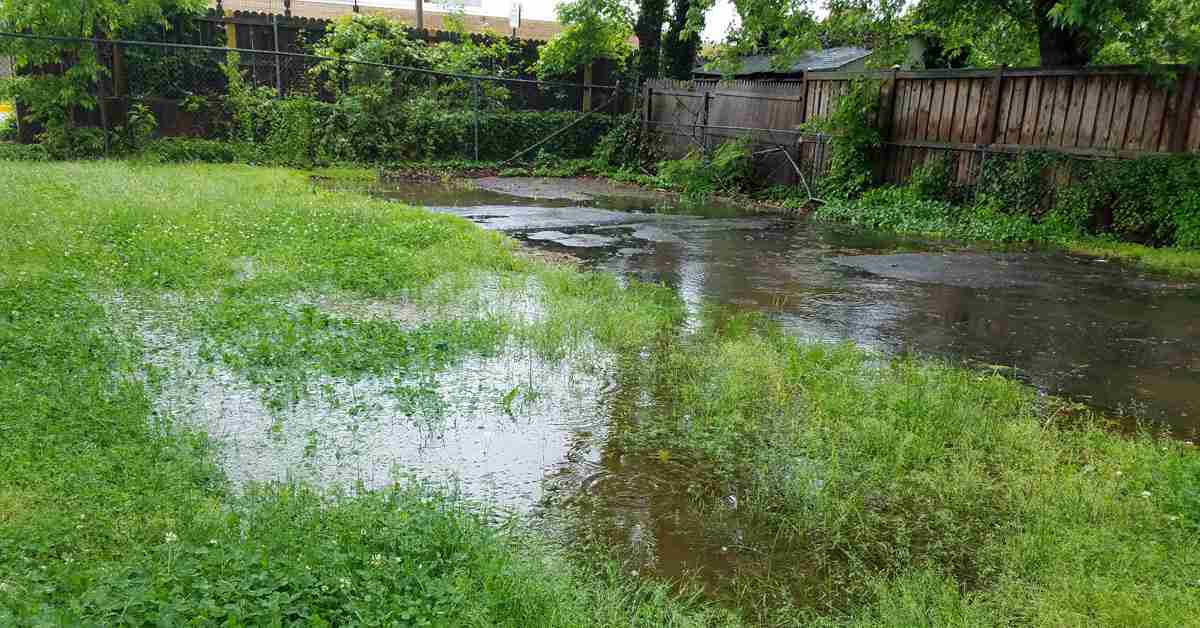
I’ve been looking at yards for close to 15 years now, and you know what I see way too often? Water sitting where it shouldn’t be.
Puddles near the foundation. Soggy patches that never dry.
Basement moisture that creeps in after every storm. And here’s the thing—most of these problems come from mistakes people make when they’re setting up their yards.
Not because they’re careless, but because they just don’t know what water does when you change the grade or add a patio or plant a tree in the wrong spot.
So I want to walk through the biggest mistakes I see.
The ones that cost people money, create headaches, and turn what should be a nice yard into a maintenance nightmare.
8 Landscaping Mistakes That Cause Water Drainage Problems
Water moves. That’s what it does. And when you landscape, you’re changing how it moves.
Every time you bring in soil, pour concrete, plant something, you’re redirecting flow.
Most people don’t think about this until they have a problem.
The mistakes I’m going to cover aren’t rare. I see them all the time, even in newer homes where you’d think someone planned things out. But they didn’t, or they planned poorly, and now water goes where it wants instead of where you want it to go.
Poor Grading Around the House
This is the big one. The number one problem I see.
Your grade—the slope of the ground around your foundation—needs to move water away from the house. Not toward it. Not flat. Away.
What happens is people add soil to create planting beds, or they level things out because they think it looks better, and they end up with ground that slopes back toward the foundation. Or it’s flat, which is almost as bad because water just sits there and slowly works its way down next to your foundation.
You want about a six-inch drop over the first ten feet away from your house. That’s the standard.
Some people do less, some do more depending on the situation, but that six-inch drop is what you’re aiming for.
I was at a house last year where the homeowner had built these really nice raised beds right against the foundation.
Looked great. But the soil in those beds was higher than the foundation itself, so every time it rained, water soaked into the beds and then sat against the house.
Basement started getting damp. Foundation started showing moisture. All because the grade was wrong.
If you’re going to add soil, you need to maintain that slope.
You can’t just pile dirt up and call it done.
Overwatering the Lawn and Plants
People water way more than they need to.
I get it. You want the grass green, you want the plants healthy. But when you overwater, you’re creating drainage problems even if your yard is graded correctly.
Overwatering saturates the soil.
When soil is saturated, it can’t absorb more water, so the next heavy rain or the next watering session just runs off or pools up.
You end up with wet spots, soggy areas, places where grass won’t grow right.
And here’s something I don’t think people realize—when you water more, you also tend to get more compaction over time, especially in clay soils.
Compacted soil doesn’t drain. So you’re making the problem worse.
I like to tell people to water deep but less often.
Let the soil dry out a bit between waterings.
Your plants will actually be healthier because their roots go deeper looking for water, and you won’t have these perpetually wet areas that cause problems.
If you’ve got an irrigation system, check it.
A lot of times zones are set to run too long or too frequently, and that’s where the trouble starts.
Using the Wrong Soil Type
Not all soil drains the same way. This seems obvious when you say it out loud, but I see people use the wrong soil all the time.
Clay soil holds water. Sandy soil drains fast. Loam is somewhere in between.
When you bring in soil for a project, you need to think about what you’re using and where you’re putting it.
I’ve seen people fill in low spots with heavy clay soil because that’s what was cheap or available, and then they wonder why water still sits there.
Well, clay doesn’t drain. You just made a clay bowl in your yard.
On the other hand, if you’re building a planting bed and you use nothing but sand, water’s going to drain through so fast your plants can’t get what they need.
You have to match the soil to what you’re trying to do.
For most situations, you want something that drains reasonably well but still holds some moisture.
A good loam or a soil mix that’s been amended with compost works for a lot of applications.
But if you’re dealing with a drainage problem, sometimes you need to get more intentional.
French drains, for example, use gravel specifically because it drains fast. That is why it is important to turn to the best French drain installation company in your area to design a system that moves water safely away from problem areas.
Ignoring Downspout Placement
Your downspouts dump a lot of water in a very small area.
If you ignore where they’re going, you’re going to have problems.
A lot of homes have downspouts that just empty right next to the foundation.
The water comes off the roof, goes through the gutter, down the downspout, and then sits right there by the house. Or it flows along the foundation until it finds a way into the basement or crawl space.
You need to extend your downspouts.
At minimum, get the water six to ten feet away from the house. Better if you can get it farther than that.
I’ve used extensions, I’ve used buried drain lines, I’ve even just graded things so the water flows away naturally once it hits the ground. But you can’t just let it dump at the foundation.
And here’s another thing—think about where that water goes after it leaves the downspout.
Is it running into a low spot in your yard? Is it flowing onto a neighbor’s property? You have to plan the whole path, not just the first few feet.
Installing Hardscapes Without Drainage Planning
Patios, driveways, walkways—they’re all hardscape, and they all affect drainage.
When you cover ground with concrete or pavers, water can’t soak into the soil anymore.
It has to go somewhere else. If you don’t plan for that, you end up with runoff problems.
I see this a lot with patios. People pour a nice big concrete patio right off the back of the house, and they either slope it toward the house or make it flat.
Water runs back toward the foundation, or it pools on the patio surface.
You have to slope hardscape away from the house.
Usually about a quarter-inch per foot is enough to move water without being noticeable. And you need to think about where that water ends up once it runs off the hardscape.
Sometimes you need a drain at the edge of the patio.
Sometimes you can just let it sheet off onto the lawn if the lawn is graded correctly. But you can’t ignore it.
Permeable pavers are an option if you want to let some water soak through, but even then you need a base that drains well.
I’ve seen permeable systems installed over clay, and they don’t work because the clay won’t let the water through.
Blocking Natural Drainage Paths
Water wants to go where it wants to go.
If there’s a natural low spot or a path where water has been flowing for years, and you block it, you’re going to have a problem.
This happens when people put in a fence, or build a retaining wall, or even just pile up mulch or soil in the wrong spot.
They block the natural flow, and the water backs up or finds a new path—usually one you don’t want.
I was at a property a few years back where the owner had put in a retaining wall to level out a slope for a play area.
Made sense for what they wanted. But the wall blocked a natural swale where water used to run down to the street.
After the wall went in, water started pooling behind it, and the whole play area turned into a muddy mess every time it rained.
They ended up having to install a drain through the wall to let the water keep moving.
Would’ve been easier to plan for that from the start.
Before you build anything or change the grade, walk your property during a rain and see where the water goes. You’ll learn a lot.
Planting in Low-Lying Areas Without Solutions
Low spots collect water. That’s just how gravity works.
Some plants can handle wet feet. Most can’t.
If you plant in a low area without addressing the drainage, you’re probably going to lose those plants, or at best they’re going to struggle and look bad.
I see this with trees especially. Someone plants a nice tree in a low spot, and within a few years it’s showing signs of stress.
Root rot, yellowing leaves, poor growth. All because it’s sitting in water too often.
You have a few options if you want to plant in a low area.
You can raise the planting bed above the surrounding grade so the roots aren’t sitting in water.
You can install drainage to move water out of that area. Or you can choose plants that tolerate wet conditions.
Rain gardens are a good solution for low spots if you design them right.
You’re basically creating a planted depression that temporarily holds water and lets it soak in slowly. But you need the right plants and the right soil mix, or it just turns into a swamp.
Skipping Proper Drainage Systems
Sometimes you need more than just good grading. You need an actual drainage system.
French drains, catch basins, channel drains, dry wells—these are tools for moving water when simple grading won’t cut it.
A lot of people skip these because they cost money or they think they can get by without them.
But if you’ve got a serious drainage problem, trying to fix it without a proper system is like bailing out a boat with a leaky bottom.
You’re just going to keep fighting the same problem.
French drains are probably the most common solution I see.
You dig a trench, line it with fabric, fill it with gravel, and run a perforated pipe to carry water away.
They work really well when they’re installed correctly.
The key words there are “installed correctly.” I’ve seen French drains that don’t slope right, or they weren’t wrapped in fabric so they clog up with soil, or they don’t actually drain to anywhere useful.
Then people say French drains don’t work, but really the installation was just done wrong.
Catch basins are good for collecting water from a specific spot, like the bottom of a driveway. Channel drains work well at the edge of hardscape.
Dry wells can be a solution if you’ve got good soil that drains well underground but you just need somewhere for surface water to go.
The point is, if you need a system, don’t skip it.
Get it designed right and installed right, and you won’t have to keep dealing with the same water problems year after year.
Conclusion
I’ve walked through a lot of yards where the owners were frustrated.
Water in the basement. Soggy spots that won’t dry. Foundation cracks. And almost every time, it comes back to one of these mistakes.
The good news? Most of these are fixable.
Some are easier than others, and some cost more than you’d like, but they’re fixable.
The better news? If you’re planning a new landscaping project, you can avoid these mistakes entirely. Think about water first.
Before you plant, before you pour concrete, before you add soil. Ask yourself where the water’s going to go.
Because water’s going to move no matter what you do.
You can either plan for it and direct it where you want, or you can ignore it and let it cause problems. I know which one makes more sense.
If you’re dealing with a drainage problem right now, start by identifying which of these mistakes might be the cause. Walk your property when it rains.
See where water collects, where it flows, where it’s supposed to go and where it actually goes.
Sometimes the fix is simple—extend a downspout, adjust the grade in one area, add some soil to create a slope.
Other times you need professional help to design and install a real drainage system.
But either way, don’t ignore it.
Water problems don’t get better on their own. They get worse, and they get more expensive to fix the longer you wait.
Take care of your yard. Plan your drainage. And you won’t have to worry about water showing up where it shouldn’t be.