Most homeowners pay close attention to shingles, gutters and roof color, but one of the most important parts of a roofing system is a narrow strip of metal that is easy to overlook.
It is called a drip edge.
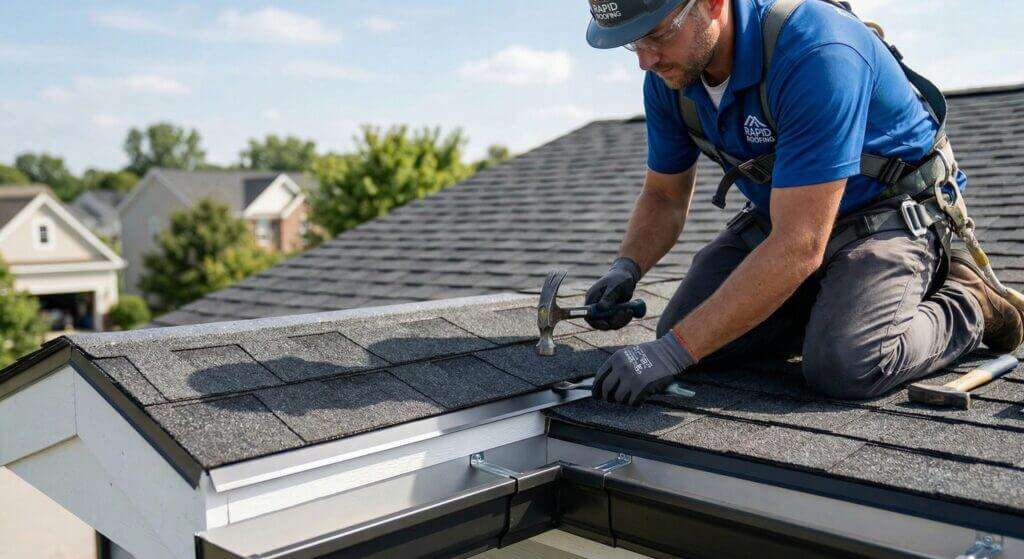
A roof drip edge is installed around the perimeter of a shingle roof to direct rainwater away from the roof deck and fascia.
Although it is a relatively small component, it plays an important role in controlling water and protecting vulnerable wood along the edge of the roof.
When drip edge is missing, damaged or installed incorrectly, water may run behind the gutter, soak the fascia or reach the edge of the roof decking.
Those problems can eventually contribute to staining, wood deterioration and leaks.
What Is a Roof Drip Edge?
A drip edge is a piece of metal flashing installed along the lower edges and sloped sides of a roof.
The lower horizontal edge of a roof is called the eave.
The diagonal edge running from the eave toward the peak is called the rake.
Drip edge is normally installed along both areas on an asphalt shingle roof.
Its shape allows it to extend beyond the edge of the roof and direct water outward.
Instead of allowing rainwater to cling to the underside of a shingle or flow toward the fascia, the metal creates a defined path away from the wood.
Drip edge is commonly manufactured from aluminum or galvanized steel and is available in different sizes, profiles and colors.
It is often selected to coordinate with the roof, gutters or exterior trim.
What Does Drip Edge Protect?
Drip edge helps protect several parts of the home.
Roof decking
The decking is the wood surface beneath the roofing materials.
At the edge of the roof, exposed or poorly protected decking can absorb water.
Over time, repeated moisture exposure can cause the wood to swell, soften or deteriorate.
Fascia
Fascia is the finished board running along the roofline.
Gutters are frequently attached to it. When water travels behind a gutter instead of flowing into it, the fascia may remain wet and begin to rot.
Soffit
The soffit is located underneath the roof overhang.
Water that bypasses the edge of the roof may stain or damage the soffit and can sometimes find a path into the attic.
Roofing underlayment
Drip edge works with the underlayment and shingles to create a complete water-management system.
These components must overlap correctly so water continues moving downward and outward rather than beneath the roofing materials.
Is Drip Edge the Same as a Gutter?
No. Drip edge and gutters perform related but different jobs.
The drip edge directs water away from the roof’s vulnerable edge.
The gutter catches that water and carries it toward a downspout.
A home can have gutters and still experience fascia damage if the drip edge is missing or positioned incorrectly.
In some cases, rainwater runs between the back of the gutter and the fascia instead of entering the gutter.
The two components work best as part of the same drainage system:
- Shingles shed the rain.
- Drip edge directs the water beyond the roof edge.
- Gutters collect the water.
- Downspouts move it away from the home.
Is Drip Edge Required on a Roof?
Modern residential roofing standards commonly call for drip edge along the eaves and rake edges of asphalt shingle roofs.
Local requirements can vary, so the applicable building code and manufacturer instructions should always be checked for the specific project.
Even when homeowners are not familiar with the term, drip edge is generally considered a standard component of a properly installed shingle roofing system.
A roof-replacement proposal should clearly state whether new drip edge is included. Homeowners should not assume it is automatically part of every contractor’s scope.
How Is Drip Edge Installed?
Correct placement depends on the part of the roof being addressed.
At the eaves, drip edge is generally installed so it works with the underlayment to move water toward the outside edge.
At the rakes, the layering sequence may differ so wind-driven rain cannot get underneath the underlayment.
Individual sections of metal must also overlap one another correctly.
If the pieces are installed in the wrong direction or separated by gaps, water can enter at the joints.
Fastener placement matters as well. Loose or widely spaced fasteners can allow the metal to lift or move during high winds.
Because the drip edge interacts with the shingles, underlayment, starter course and gutters, installation is easiest during a full roof replacement.
Can Old Drip Edge Be Reused?
Sometimes old drip edge appears serviceable from the ground, but reusing it is not always the best option.
The metal may be bent, corroded, improperly sized or secured beneath old roofing materials.
Removing shingles can also damage it.
If the existing drip edge was installed incorrectly, reusing it carries the same problem into the new roofing system.
New drip edge also allows the contractor to coordinate the roof edge with the new underlayment, starter shingles and gutter position.
Homeowners comparing bids should ask whether the contractor plans to:
- Install completely new drip edge
- Reuse the existing metal
- Replace only damaged sections
- Remove and reinstall the gutters
- Match the new metal to the roof or trim color
These details can explain why two roof-replacement proposals with similar shingle selections have different prices.
What Are the Signs of a Drip-Edge Problem?
Drip edge is not always visible from the ground, but certain symptoms may indicate a problem.
Common warning signs include:
- Water running behind the gutters
- Peeling paint or stains on the fascia
- Soft or rotted wood along the roof edge
- Gaps between the metal and the roof
- Bent or missing sections of edge metal
- Water stains beneath the roof overhang
- Shingles curling at the perimeter
- Pest activity near exposed roof edges
These symptoms do not automatically mean that the drip edge is the only issue.
Gutters may be clogged, improperly pitched or mounted too low.
The shingles may also be too short, damaged or incorrectly installed.
A professional inspection can determine how the components are interacting.
Why Drip Edge Matters in Heavy Rain and Wind
Roof edges are particularly vulnerable during wind-driven rain because water does not always fall straight downward.
Strong wind can push rain beneath lifted shingles or toward gaps around the perimeter.
Properly installed drip edge helps close off the roof edge and guide water away from the wood below.
It can also help support the outer edge of the shingles and create a cleaner finished appearance.
In areas that experience severe thunderstorms, hail and strong winds, details at the roof perimeter deserve the same attention as the shingles themselves.
Should Drip Edge Be Replaced During a New Roof Installation?
In many cases, replacing the drip edge during a full roof replacement is the most practical approach.
Once the existing shingles have been removed, the roofing contractor can inspect the decking, fascia and perimeter conditions.
Any damaged wood can be identified before the new system is installed.
A contractor can then integrate the new drip edge with the underlayment, starter shingles and gutters.
This creates a more complete system than replacing shingles alone.
Homeowners planning a roof replacement in Austin should ask for a written scope showing the specific edge metal, underlayment, flashing and ventilation components included in the price.
Small Roofing Components Can Prevent Large Problems
Drip edge is inexpensive compared with shingles, decking or interior water-damage repairs, but its importance should not be underestimated.
A roofing system is only as reliable as the way its components work together.
Shingles provide the visible surface, but underlayment, flashing, starter shingles, ventilation and edge metal all contribute to long-term performance.
Experienced contractors such as Driftwood Builders Roofing evaluate the entire roofing system rather than focusing only on the visible shingles.
Before approving a roof replacement, homeowners should confirm that drip edge is included, find out whether the existing metal will be removed and ask how the roof edge will connect with the gutters.
That small conversation can help prevent much larger problems later.
Frequently Asked Questions
Drip edge directs water away from the roof decking and fascia. It helps prevent rainwater from traveling underneath shingles or behind the gutters.
It is normally installed along the eaves and rake edges of an asphalt shingle roof.
Missing drip edge can allow water to reach the roof deck, fascia or soffit. It may contribute to leaks and wood deterioration, although other roofing or gutter problems may also be involved.
The drip edge should be positioned so water is directed into the gutter rather than behind it. The exact relationship depends on the roof and gutter configuration.
Replacing it is often recommended when the old metal is damaged, corroded, improperly installed or difficult to integrate with the new roofing system.
It can be matched to the shingles, fascia, gutters or exterior trim. Color is primarily an aesthetic decision, while material, size and installation affect performance.