
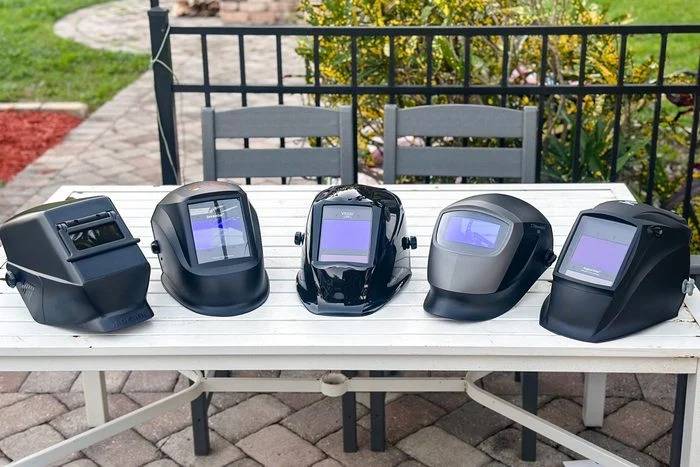
Custom metal furniture has taken over the home design market, from steel table bases and industrial shelving to custom railings and pieces that cost thousands retail but are totally doable in a home shop.
I’ve been building metal furniture for my house for about three years.
Started with a console table, moved to floating shelves, and eventually fabricated an entire outdoor space for dining set.
The lesson I learned fast: your helmet matters more than you think.
A cheap one makes the work frustrating. Your eyes tire out.
You can’t see the puddle well enough for clean beads.
After testing different setups, here’s what actually works for furniture projects where quality shows.
Ridge Products Welding Royal Series Lenses (With Compatible Helmets)
Most helmet reviews focus on the shell, headgear, and buttons. But the lens is what actually determines your welding experience.
Ridge Products Welding built their business around this idea: quality auto-darkening lenses that fit standard 2×4 helmets.
Their approach is practical for weekend work.
Use their Throne pipeliner hood or drop their lenses into your existing Jackson, Fibre-Metal, or Honeywell setup. No proprietary lock-in.
The King 2.0 adjustable lens offers gold-tinted true-color technology for natural puddle visibility without a harsh green cast.
Shade adjustability from 5 to 13 covers plasma cutting through heavy flux-core.
The 1/25,000-second darkening response works across different processes, and the 1600-hour lifespan handles years of weekend projects.
The Heir single-shade lens provides a fixed shade of 10 with no settings.
The Prince silver lens features adjustable shades in a neutral silver tone, preferred by some welders for mild steel.
Ridge’s lenses use true-color filtering typically found in pricier helmets.
For furniture work, that clarity helps you catch issues before they become problems.
You clearly see heat-affected zones, spot undercut early, and keep bead placement consistent.
At around $80 to $160 per lens, they sit between budget and premium price points.
The Throne hood weighs 16.3 ounces with a flip-up design for tack-check-grind cycles.
Hard hat compatible for shop work. Users report seeing gas coverage on aluminum TIG and reduced eye fatigue during long sessions.
Visit ridgeproductswelding.com to see their lens collection and helmet options.
Lincoln Viking 3350
Lincoln Electric’s Viking 3350 shows up in home shops for clear reasons.
The 4C lens delivers 1/1/1/1 optical clarity (highest EN 379 rating), and 12.5 square inch viewing area helps when positioning large furniture pieces.
The external grind button saves time on tack-weld-grind cycles.
The X-6 headgear distributes weight reasonably, though comfort could be better. Lincoln backs it with a five-year warranty, longest in the industry.
As Kevin Beckerdite, Global Product Manager for PPE at ESAB, notes: “Welders are very particular people.
They take a ton of pride in their work and tend to shoot for the very highest-quality outcome.
If they’re not using the right type of welding helmet, they won’t feel like the work is at the top level” (Beckerdite, personal communication, as cited in MSD Direct, 2024).
The Viking performs consistently. At $350 to $400, it’s a solid mid-range choice for reliable performance.
Miller Digital Elite
Miller Electric’s Digital Elite features a digital control interface and weighs less than many competitors’ models.
That matters during long sessions at awkward angles, welding table legs or frame assemblies.
Digital controls provide precise shade adjustment.
Auto-darkening stays consistent across MIG and TIG work. Optics provide acceptable clarity for home-shop applications.
Beckerdite emphasizes comfort’s role: “If you’re not comfortable with what you’re wearing, you’re not going to want to do the job, or you’re not going to want to do it safely” (Beckerdite, personal communication, as cited in The Fabricator, 2023).
The headgear is functional but gets mixed feedback on fit security.
At $300 to $350, it’s a competent option with a recognizable brand name.
ESAB Sentinel A50
ESAB’s Sentinel A50 has a distinctive spherical design. The true-color lens technology aims to reduce eye strain with more natural color balance.
The 1/1/1/2 optical class rating (one step below top 1/1/1/1) provides clear viewing for most applications.
The HALO headgear offers multiple adjustments. The external grind mode button matches convenience features on other premium helmets.
Beckerdite explains lens technology importance: “It’s all about the wavelength of the light.
We try to knock out the types of light that strain your eyes: blue light and excessively bright light, for example” (Beckerdite, personal communication, as cited in MSD Direct, 2024).
The A50 performs adequately for weekend work. At $300 to $400, it’s similar in performance and price to the Viking and Miller options.
What Actually Matters in a Welding Helmet
After building enough furniture to outfit most of my house, here’s what I’ve noticed: everyone focuses on helmet shells, headgear, and external buttons.
Now, of course, those matter, but they’re secondary to lens quality, which actually determines what you see.
Optical clarity ratings, true-color technology, and auto-darkening response all directly impact your ability to produce quality welds.
A wobbly bead on a table base shows. Poor lens optics translate to lower-quality finished pieces.
Professional fabricators focus on lens specs first, then choose shells around those lenses. Weekend warriors should do the same.
Identify the lens technology that matches your work (true-color for visibility, adjustable shades for flexibility, fast response for protection), then pick a comfortable helmet shell.
Your furniture projects benefit from this lens-first approach.