
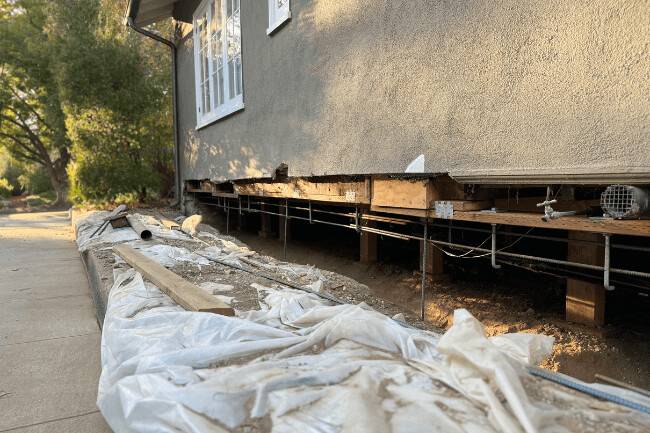
Your foundation sits there, buried under your house, doing its job day after day.
You probably don’t think about it much. Until you notice that crack in your basement wall getting wider. Or your doors suddenly won’t close right.
Weather does more damage to foundations than most homeowners realize. And I’m not just talking about the obvious stuff like floods.
We’re talking freeze-thaw cycles, drought conditions, heavy rains, even the temperature swings between seasons. All of it matters.
How Weather Affects Foundation
Let me be straight with you. Foundations fail because of moisture changes in the soil around them.
That’s really what we’re talking about when we say “weather damage.”
The weather changes the moisture content in your soil, and that soil expands or contracts, and your foundation has to deal with all that movement.
Understanding How Foundations Work
Think about what a foundation actually does.
It’s transferring the entire weight of your house down into the soil below.
Every wall, every piece of furniture, every person walking around upstairs, all that weight is pushing down through your foundation and spreading out into the ground.
Most residential foundations are one of three types.
Slab on grade, where concrete floor gets poured right on the dirt.
Crawl spaces, which give you a little breathing room under the house. Or full basements, which go deep into the ground.
Here’s the thing, though.
All three of these foundation types are sitting in or on soil. And soil moves.
When soil gets wet, it expands. Clay soil is the worst for this. It can swell up significantly when it absorbs water.
Then when it dries out? It shrinks back down. Your foundation is just along for the ride, whether it wants to be or not.
How Different Weather Conditions Affect Your Foundation
Heavy Rain and Flooding
When you get a lot of rain in a short period, that water has to go somewhere.
If your gutters aren’t working right, if your yard doesn’t slope away from the house, that water is going to pool right up against your foundation.
Water sitting against your foundation creates hydrostatic pressure.
That’s just a fancy way of saying the water is pushing against your foundation walls, trying to find a way in. And it will find a way. Through cracks, through the joint where your wall meets your footing, anywhere there’s a weakness.
But that’s not even the worst part.
The worst part is what happens to the soil.
When soil gets saturated, it expands. That expansion pushes against your foundation from the sides.
You’ve got pressure from the water and pressure from the swollen soil. That’s when you start seeing cracks form or existing cracks get worse.
Drought Conditions
You’d think dry weather would be better for your foundation. No water means no water damage, right?
Wrong.
When soil dries out, especially clay soil, it shrinks.
It pulls away from your foundation.
Now you’ve got gaps where the soil used to be supporting your foundation walls. That foundation might settle unevenly.
You might see cracks. Your doors and windows might start sticking.
I’ve seen houses in Texas where the soil pulled back so far during a drought that you could see daylight between the foundation and the dirt. That’s not good.
Freeze-Thaw Cycles
Up north, this is the big one. Water gets into small cracks in your concrete.
When temperatures drop below freezing, that water turns to ice. And ice expands. It makes those small cracks bigger.
Then it warms up. The ice melts. More water gets into the now-bigger crack.
It freezes again. Expands more. You can see where this is going.
This same freeze-thaw action happens in the soil around your foundation, too.
Frozen soil expands and pushes against your foundation. When it thaws, it contracts. All that back and forth movement takes a toll.
Temperature Swings
Even without freezing, big temperature changes cause problems.
Concrete expands when it’s hot and contracts when it’s cold. Not by much, but over time, those tiny movements add up.
The soil is doing the same thing. Expanding in heat, contracting in cold.
Your foundation is constantly adjusting to these changes.
Warning Signs Weather May Be Damaging Your Foundation
So how do you know if weather is messing with your foundation? Here’s what to watch for.
Cracks
Not all cracks are created equal.
Hairline cracks in concrete are pretty normal.
Concrete cures and settles, and you get some minor cracking. That’s okay.
What you don’t want to see are cracks wider than a quarter inch. Horizontal cracks. Stair-step cracks in brick or block walls.
Cracks that seem to be growing. Any crack that’s letting water through.
If you can stick a credit card in a crack, you need to pay attention to it.
Doors and Windows Acting Up
When your foundation shifts, your entire house shifts with it. Doors that used to close fine suddenly stick. Windows won’t open or won’t stay open. Gaps appear between doors and their frames.
This happens because your house is no longer sitting level.
The foundation moved, the walls moved, and now nothing lines up quite right anymore.
Uneven Floors
Walk around your house barefoot sometime.
Do you notice any areas where the floor seems to slope? Put a marble down. Does it roll?
Sloping floors can mean your foundation has settled unevenly.
Maybe one corner sank more than the others. Maybe the middle of your slab dropped.
Water in the Basement or Crawl Space
This one’s obvious, but it’s worth mentioning.
If you’re getting water inside, your foundation’s defense against weather has already failed. Water is getting through somewhere.
Even if you don’t see standing water, check for dampness.
A musty smell. Efflorescence, which is that white chalky stuff that appears on concrete when water evaporates out of it.
Gaps Around Exterior Fixtures
Check where things attach to your house.
Your chimney, your porch, your garage.
Are there gaps forming between these structures and your main house? That can mean differential settling. Parts of your foundation are moving at different rates.
Regions Where Weather-Related Foundation Problems Are Most Common
Some parts of the country just have it worse than others when it comes to foundation problems.
The South and Southwest
Texas, Oklahoma, parts of Louisiana.
Basically anywhere with expansive clay soil.
This soil swells dramatically when wet and shrinks dramatically when dry. Houses in Dallas and Houston deal with this constantly.
The weather patterns make it worse.
You get long dry spells, then sudden heavy rains. The soil can’t handle those extreme swings.
The Midwest
Illinois, Missouri, Kansas. These states deal with both clay soil and freeze-thaw cycles. Double trouble.
In areas like western Kentucky, understanding how weather affects foundations can help homeowners recognize problems early and avoid costly structural repairs, including the need for Ownesboro, KY foundation repair services.
Northern States
Minnesota, Wisconsin, Michigan. Anywhere with harsh winters.
The frost line goes deep, and that freeze-thaw action I talked about earlier happens every single year.
If your foundation wasn’t poured deep enough to get below the frost line, you’re going to have problems.
Coastal Areas
Florida, the Carolinas, Gulf Coast states.
High water tables, heavy seasonal rains, hurricanes. Flooding is the main issue here, along with soil erosion washing away the support under foundations.
How to Protect Your Foundation From Weather Damage
Okay, so weather is trying to destroy your foundation. What can you do about it?
Manage Water Around Your House
This is the big one. Control where water goes, and you’ve solved half your foundation problems right there.
Your gutters need to work. Clean them out twice a year, minimum.
Make sure downspouts are attached and actually carrying water away from the house.
I like to see downspouts dump water at least 6 feet away from the foundation. Use extensions if you need to.
Grade your yard so it slopes away from the house.
You want at least a 6-inch drop over the first 10 feet. That gives water a path to flow away instead of pooling against your foundation.
Don’t plant water-hungry trees or shrubs right next to your house.
Their roots will pull moisture from under your foundation, which causes soil shrinkage and settlement. Keep big trees at least 20 feet away.
Maintain Consistent Soil Moisture
This sounds weird, but in areas with expansive clay soil, you actually want to keep the moisture level in your soil relatively consistent.
Not soaking wet, just consistently damp.
Some people run a soaker hose around their foundation during dry periods.
It keeps the soil from shrinking away from the foundation.
Your engineer or foundation specialist can tell you if this makes sense for your situation.
Install or Maintain Foundation Drainage
A lot of houses, especially ones with basements, have a drainage system around the foundation. French drains on the outside that collect water and direct it away.
Maybe a sump pump on the inside.
These systems need maintenance.
Drains can clog. Sump pumps can fail. Check them, especially before rainy season.
Seal Cracks Promptly
Small cracks can become big cracks.
Water gets in, freeze-thaw happens, and suddenly your hairline crack is a serious structural issue.
Seal minor cracks with appropriate concrete filler or epoxy.
For anything more than superficial, get a professional opinion first. You don’t want to just cover up a symptom of a bigger problem.
Watch Your Sprinklers
I see this all the time.
Sprinklers pointed at the house, soaking the foundation every time they run. That’s terrible for your foundation. Adjust those heads so water goes on your grass, not your concrete.
When to Call a Foundation Professional
Some stuff you can handle yourself.
Cleaning gutters, fixing grading, sealing small cracks. But there’s a point where you need to bring in someone who does this for a living.
Call a foundation professional if:
You see cracks wider than a quarter inch.
Horizontal or stair-step cracks. Any crack that’s growing.
Water coming through your foundation walls.
Significant settling or unevenness. Doors and windows throughout the house not working right. You notice bowing or leaning in foundation walls.
A foundation inspection usually isn’t that expensive.
Sometimes it’s free if you’re considering repair work with that company. They’ll come out, evaluate what’s happening, and give you options.
Here’s my advice on that, though. Get more than one opinion.
Foundation repair can be expensive, and not every company is going to recommend the same approach.
Some might try to sell you way more than you need. Get at least two or three estimates before you commit to major work.
And make sure whoever you hire is properly licensed and insured. Ask for references.
Check their reviews. Foundation repair is not where you want to hire the cheapest guy who showed up in your Facebook feed.
Conclusion
Weather affects your foundation. That’s just reality. Rain, drought, freezing, heat, all of it puts stress on the concrete and the soil supporting your house.
But here’s the good news. Most weather-related foundation damage is preventable.
Manage water correctly. Keep an eye out for warning signs. Address small problems before they become big ones.
Your foundation was built to last.
Give it a fighting chance by protecting it from the weather, and it’ll keep your house standing solid for decades to come. That’s really all you can ask from concrete and dirt, right?