
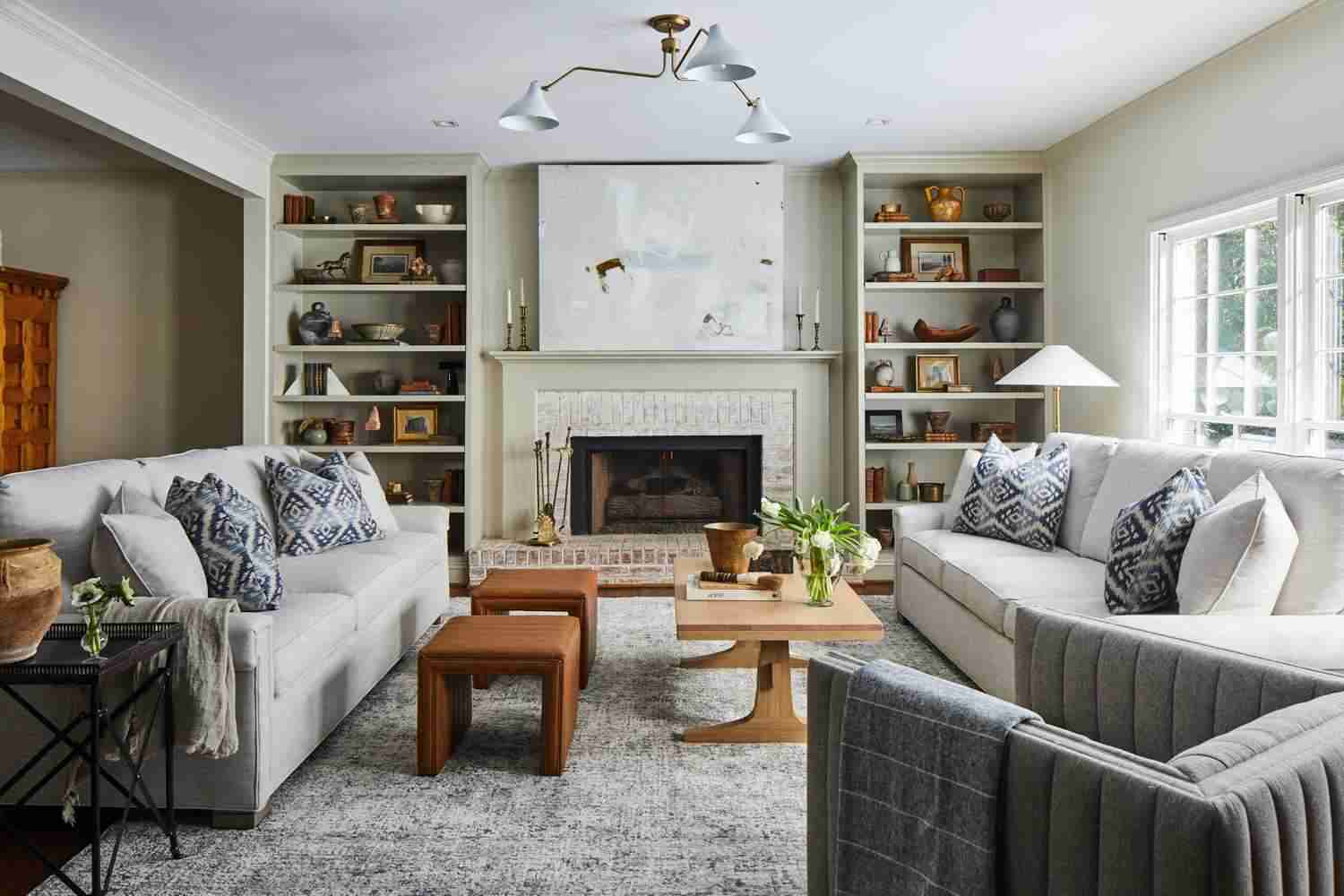
Okay so here’s the thing about tall walls—they’re kind of a blessing and a curse at the same time.
You move into this beautiful space with those soaring ceilings and you’re like yes this is amazing. Then about three days later you’re standing there staring at this massive blank wall thinking what the hell am I supposed to do with this?
I’ve been writing about interior design for over fifteen years now and I can’t tell you how many times I’ve heard this exact problem.
Homeowners get stuck. They either leave the wall completely bare because they’re scared of messing it up, or they go the opposite direction and just start throwing stuff up there until it looks like a chaotic mess.
Neither option is great.
The truth is tall walls need a different approach than your standard eight-foot situation.
You can’t just hang a piece of art at eye level and call it a day. But you also can’t treat it like a giant bulletin board and cover every inch.
What you need is intention. Restraint, actually.
I know that sounds counterintuitive when you’re dealing with so much space but trust me on this one.
The best tall wall treatments I’ve seen in my career—from celebrity homes to everyday family rooms—they all have one thing in common. They know when to stop.
So let me walk you through eight ways to handle these walls without making your space feel cluttered or overwhelming.
These are techniques I’ve seen work over and over again in real homes with real people.
8 Ideas for Filling Tall Walls Without Making Them Busy
Here’s what works. Not theory, actual proven methods.
Why Less Is More for Tall Wall Decor
Look I get it. You have all this vertical real estate and it feels wasteful to not use it.
But here’s what happens when you over-fill a tall wall—your eye doesn’t know where to land.
Everything competes for attention and the whole space starts feeling anxious. Cramped, even though you literally have high ceilings.
The magic happens when you give elements room to breathe.
Think about it like this.
When you walk into a room, your eye naturally travels upward on tall walls.
If that journey is cluttered with too many stops along the way, it’s exhausting. But if there are just a few intentional moments? That’s when a space feels expensive. Curated.
I learned this the hard way early in my career actually.
I was working on a piece about a designer’s personal home and they had this two-story house. Gorgeous.
They’d put up maybe three things total on this massive wall and I remember thinking that’s it? Felt wrong at first. But when I saw the photos and visited in person, it made perfect sense.
The restraint was the statement.
Less is more isn’t just some design cliche here. It’s actually the answer.
Oversized Art as a Statement Piece
This one never fails.
When you’re dealing with a tall wall, scale becomes your best friend. Instead of filling the space with multiple smaller pieces, go big. I mean really big.
Many designers rely on oversized wall art to achieve this balance.
A single large-scale piece can anchor an entire wall without making it feel busy. You get impact without chaos.
I’ve seen this work with everything from abstract paintings to photography to even textile art.
The key is making sure the piece is actually large enough. And I mean people always underestimate this.
They think oh this is pretty big and then it gets on the wall and looks like a postage stamp.
Here’s a rough guide—for a wall that’s 12 feet or higher, you’re probably looking at art that’s at least 4 feet in one dimension. Maybe more depending on the wall width.
You want it to feel substantial. Grounded.
Frame it or don’t, that’s a personal choice. But the size matters more than almost anything else. One powerful piece beats five medium ones every single time on a tall wall.
Create Vertical Panels or Sections
Millwork is having a moment right now but honestly it’s been a solution forever.
Board and batten, picture frame molding, vertical paneling—any of these can break up a tall wall without adding visual clutter. Because here’s the thing, you’re adding dimension but not objects.
I love this approach for people who want their walls to feel finished but don’t want to commit to hanging a bunch of stuff. The architecture does the work for you.
You can paint these panels the same color as your wall for something subtle. Or go bold with contrast.
I’ve seen people do the lower two-thirds in paneling and leave the upper section plain. That can work too, actually probably works better sometimes because you’re not forcing the eye all the way up.
The vertical orientation is key here though.
Horizontal lines on a tall wall can make it feel cut in half, which defeats the purpose. Vertical draws the eye up in a natural way.
Cost-wise this is an investment but it’s permanent.
You’re not going to get sick of it the way you might with a trendy art piece. And if you’re even remotely handy or know someone who is, board and batten is pretty approachable as a DIY.
Use Tall Shelving Strategically
Shelving can go one of two ways—it either saves you or drowns you.
The mistake people make is putting up floating shelves and then filling every inch with tchotchkes and photo frames and books stacked every which way. That’s not decor, that’s just… a lot.
But tall shelving done right? Chef’s—wait no I can’t say that, it’s on the banned list. It’s really good. Let’s put it that way.
What you want is a tall bookshelf or shelving unit that has presence but isn’t overstuffed. Style it with intention. Some books, sure.
A few objects that actually mean something. Negative space is your friend here.
I saw this approach in a home tour I covered a few years back—they had a wall that was easily 16 feet tall in their library.
They installed floor-to-ceiling built-ins but only filled about 60% of the shelf space. The rest was just empty. Breathing room.
It looked expensive. Looked collected over time instead of bought all at once.
If you’re using open shelving, think about rhythm too.
Don’t put something on every single shelf. Let some stay empty or nearly empty. That contrast is what makes the styled sections stand out.
Incorporate Mirrors to Open Up Space
Mirrors are kind of cheating but in the best way.
A tall mirror or a collection of mirrors can fill your wall space while actually making the room feel bigger.
They reflect light, they reflect views, they add depth. And they don’t add visual weight the way a dark piece of art might.
I’m partial to leaning a huge floor mirror against a tall wall rather than hanging it, actually.
There’s something casual about that. Less precious. Though obviously you need to secure it if you have kids or pets running around.
You can also do a grid of smaller mirrors if you want something more structured.
I’ve seen this done with vintage mirrors that don’t match perfectly and it has this collected-over-time feel that’s really warm.
The thing about mirrors on tall walls is they trick your eye.
The wall doesn’t feel as imposing because you’re not just staring at a flat surface. You’re seeing the room reflected back, which creates layers.
Just be thoughtful about what the mirror is reflecting. You don’t want it bouncing back a view of your clutter or an awkward angle. That’s where placement matters.
Vertical Gallery Walls (Done Right)
Gallery walls can absolutely work on tall walls but you have to rethink the format.
The traditional approach—a cluster of frames grouped together in the center of the wall—that works for normal-height walls. For tall walls you need to think vertical.
What I mean is create a gallery arrangement that travels up the wall rather than spreading out horizontally. You’re working with the height, not fighting it.
Keep your frames consistent. Same style, same color, same mat situation if you’re using mats. That cohesion is what keeps it from looking messy even as you go up the wall.
And here’s something I don’t see people talk about enough—you need to have a clear bottom line. Start your gallery at a reasonable height, probably around 60 inches from the floor for the bottom frame, and then build up from there.
If you start too low it looks like the frames are sliding down the wall. Too high and they’re disconnected from the room.
Spacing matters too. Don’t cram them together. Give each frame some space to exist on its own while still being part of the group.
I’d say you can go up to 12 or 15 frames on a really tall wall but beyond that you’re pushing it.
Even if you have more wall to fill, sometimes stopping short of the ceiling is the right call.
Add Texture Instead of More Items
This is where you get to be smart about it.
Texture fills space without adding visual clutter.
A woven wall hanging, a textural plaster finish, wallpaper with dimension—these things create interest but your eye reads them as one thing, not a collection of things.
I’m seeing a lot of lime wash and Roman clay plaster finishes right now and they’re perfect for tall walls.
You get this organic variation in color and texture that catches light differently throughout the day. It’s subtle but it makes the wall feel alive.
Grasscloth wallpaper is another go-to.
The natural texture gives you depth without pattern, so it doesn’t compete with your furniture or art.
Or go full statement with a large-scale fiber art piece.
Macrame, woven textiles, even a vintage rug hung on the wall—these have enough texture and scale to hold their own on a tall wall without needing backup.
The benefit here is you’re addressing the wall without adding a dozen things to it. One textural moment can be enough.
Highlight with Lighting
Okay this one is going to cost you but wow does it pay off.
Using lighting as your wall treatment is kind of genius because it’s functional and decorative at the same time.
Sconces running up a tall wall, a statement pendant that hangs in front of it, even uplighting that washes the wall with light—these all fill the space without physical clutter.
I covered a home last year that had a 20-foot wall in the entryway.
No art, no mirrors, nothing. Just three massive lantern sconces installed vertically and that was it. It was stunning.
The scale of the fixtures matched the scale of the wall and the light itself became the feature.
You can also use lighting to highlight something else on the wall.
Picture lights on a large art piece, or LED lightning strips behind floating panels for a subtle glow.
This approach works especially well in spaces where you want drama but not necessarily color or pattern.
The light creates shadow and dimension, which fills the space in an almost architectural way.
Not cheap like I said. But if you’re stuck on what to do with a tall wall and you have the budget, lighting might be your answer.
Conclusion
So there you have it. Eight real ways to handle tall walls without turning them into a visual nightmare.
The thread running through all of these? Restraint. Intention. Scale.
You don’t need to fill every inch. You need to fill it thoughtfully.
Pick one or two of these approaches and commit to them rather than trying to do everything at once.
And honestly, if you’re standing in front of your tall wall right now feeling overwhelmed, just start with one thing. Maybe that’s a large piece of art. Maybe it’s some vertical paneling. See how it feels. Live with it for a minute.
Tall walls are a gift once you figure them out.
They give your home drama and presence and they make spaces feel special.
You just have to stop fighting against the height and start working with it instead.
Your wall doesn’t need more stuff. It needs the right stuff. There’s a difference.