
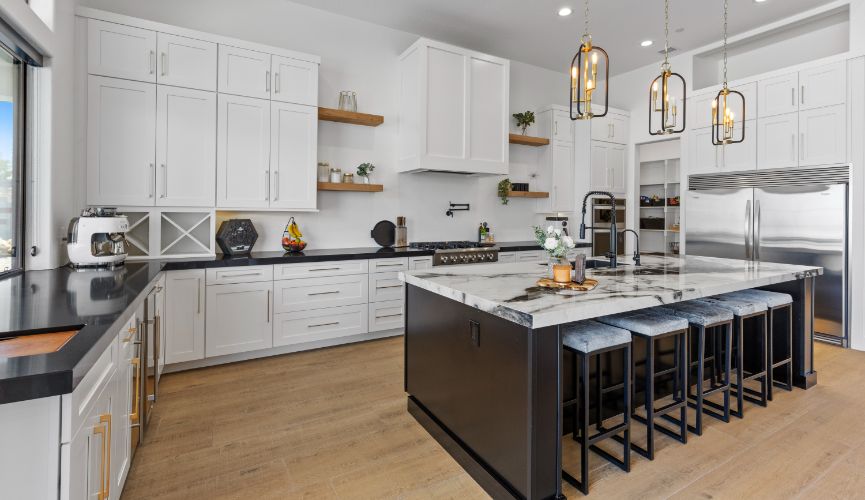
So you’re standing in your kitchen right now, probably looking at those outdated cabinets or that worn countertop, and you’re asking yourself: do I go all in or just freshen things up a bit?
It’s a real question. And honestly, the answer isn’t the same for everyone.
Here’s what I’ve learned after covering hundreds of kitchen projects and talking to homeowners who’ve been exactly where you are right now.
The ROI conversation—return on investment, if we’re being formal about it—isn’t just about numbers on paper.
It’s about your timeline, your market, what you actually need from the space, and yeah, what you can afford without losing sleep.
This isn’t going to be one of those articles that tells you there’s a perfect answer.
Because there isn’t. But what I can do is break down what each option actually means, what it costs, and what you’re likely to get back when you sell. Or if you’re staying put, what makes sense for how you live.
Let’s get into it.
Differentiate between Kitchen Remodel VS Minor Upgrade And Which delivers Better Returns
Before we jump into which one gives you better returns, we need to get clear on what we’re actually comparing here.
A full kitchen remodel and a minor upgrade aren’t even playing in the same league.
Different costs, different timelines, different results. And yeah, different returns when it comes time to sell or refinance.
The thing is, most people hear “kitchen remodel” and think it automatically means ripping everything out and spending sixty grand.
Not always true. And when someone says “minor upgrade,” you might picture just slapping on a fresh coat of paint. Also not really accurate.
So let me break down what each one actually involves, what the numbers look like, and where your money goes.
What Defines a Full Kitchen Remodel?
Alright, a full remodel. This is the big one.
We’re talking about changing the layout, replacing cabinets, new countertops, probably new flooring, updated lighting, new appliances.
Sometimes you’re moving walls. Sometimes you’re relocating plumbing or electrical. It’s a project, not a weekend thing.
You’re typically looking at costs somewhere between $25,000 and $75,000 for a full remodel.
I know that’s a huge range, but kitchens vary wildly.
An 8×10 galley kitchen isn’t going to cost what a 15×20 open-concept space costs. And the materials you choose? That’s where things really swing.
Custom cabinets versus stock cabinets. Quartz versus laminate. You get it.
A full remodel usually takes anywhere from 6 to 12 weeks.
Sometimes longer if you hit permit delays or supply chain issues, which, let’s be honest, still happens more than it should.
What are you getting for that investment? A completely different kitchen. New functionality, modern aesthetics, better flow.
If your current kitchen layout doesn’t work—like your fridge is blocking the walkway or you have zero counter space next to the stove—a full remodel fixes that.
The labor component here is significant.
You’re paying for demo work, cabinet installation, countertop templating and install, plumbing hookups, electrical work, maybe some drywall repair, flooring, backsplash tile work.
It adds up fast.
But here’s the thing about a full remodel. If you’re in a market where kitchens sell homes, this can be worth it. Not always, but often.
What Counts as a Minor Kitchen Upgrade?
Now, a minor upgrade is a different animal.
You’re keeping the existing layout. Cabinets stay where they are.
You’re not moving appliances around or tearing out walls. What you are doing is refreshing what’s already there.
This might mean repainting or refacing cabinets, updating hardware, replacing countertops, adding a new backsplash, swapping out the faucet and sink, maybe updating light fixtures.
You might throw in new appliances if the old ones are dying, but you’re not changing where they go.
Cost-wise, you’re usually looking at $5,000 to $20,000. Again, range depends on what you’re doing and what materials you choose.
Timeline? Much shorter. A minor upgrade can often be done in 1 to 3 weeks, sometimes even less if you’re just doing cabinet painting and hardware.
The labor is less intensive too.
You might have a painter, someone to install the countertops, maybe a handyman to swap out the sink and faucet. But you’re not paying for electricians to relocate outlets or plumbers to reroute gas lines.
What you get is a refreshed space that looks updated without the major construction headache.
If your layout already works and you just hate the aesthetics, this route makes a lot of sense.
The catch? You’re limited by what’s already there.
If your cabinets are falling apart or your layout is terrible, a minor upgrade is just putting lipstick on a pig. Not a great investment at that point.
Comparing ROI: Kitchen Remodel vs. Minor Upgrade
Okay, let’s talk numbers. Real numbers.
According to Remodeling Magazine’s Cost vs. Value Report—which tracks this stuff annually—a minor kitchen remodel typically recoups about 72% to 83% of its cost at resale.
A major midrange kitchen remodel? You’re looking at about 54% to 62% recoup rate.
Wait, so the cheaper option has better ROI?
Yep. On paper, the minor upgrade wins.
But hold on. That’s not the whole story.
Those percentages are national averages.
Your actual return depends heavily on your local market, the current condition of your kitchen, and what buyers in your area expect.
If you’re in a neighborhood where every other house has a renovated chef’s kitchen and yours has cabinets from 1987, that full remodel might recoup more than 62% because you’re bringing your home up to market standard. You’re removing a barrier to sale.
On the flip side, if you’re in a modest neighborhood where most homes have basic but functional kitchens, spending $60,000 on a high-end remodel is probably overbuilding for the market. You won’t get that money back.
Here’s something else people don’t always consider. Time horizon matters.
If you’re selling within a year or two, you care about immediate resale value.
The minor upgrade often makes more sense because you get a solid return without as much capital outlay.
But if you’re staying in the home for another 10 or 15 years? The quality-of-life return on a full remodel might matter more than the financial return at resale. You’re going to use that kitchen every single day.
No matter which route you take, keeping the ROI of kitchen remodel in mind will help you make choices that are smart for both your home and your budget.
Market Factors That Influence Your Return
Your ZIP code matters. A lot.
In hot real estate markets—think suburban areas with good schools, desirable urban neighborhoods, places where inventory is tight—kitchen remodels tend to recoup more.
Buyers expect updated kitchens and will pay for them.
In slower markets or areas where homes are generally older and less updated, you might not see as much return.
Buyers there might be planning to renovate themselves or they’re more price-focused than amenity-focused.
Age of the home plays a role too. If you have a 1950s ranch that still has most of its original features, a kitchen update is expected.
It’s almost priced into what buyers anticipate spending. But if you have a 10-year-old home, a full remodel might not add as much value because the kitchen probably isn’t that outdated yet.
Comparable homes in your area—this is huge.
What have kitchens in recently sold homes looked like? If they’re all updated and yours isn’t, you’re at a disadvantage.
If they’re all original and you update yours, you stand out.
The condition of the rest of the house matters too.
A brand new kitchen in a house that otherwise needs work can feel mismatched.
Buyers might wonder why you invested in the kitchen but ignored the roof or the outdated bathrooms.
And then there’s timing. If you’re renovating right before a market downturn, your return will be lower than if you’d sold during a peak.
Obviously, you can’t always control that, but it’s worth being aware of.
Lifestyle vs. Investment: Choosing the Right Approach
Okay, so we’ve talked about financial return. But here’s where I think the conversation needs to shift a bit.
Not every kitchen project should be evaluated purely on resale ROI.
Sometimes you’re doing it because you hate cooking in your current kitchen. Or because your family has grown and you need more storage. Or because the layout is genuinely dysfunctional.
If you’re planning to stay in your home for the long haul—say 10 years or more—the lifestyle return starts to matter more than the resale return.
Think about it. If a full remodel costs $50,000 and you live with it for 10 years, that’s $5,000 a year. Or about $416 a month.
For a space you use multiple times every single day.
When you frame it that way, the value equation changes.
You’re not just thinking about what a buyer will pay in 2035. You’re thinking about whether your daily life improves enough to justify the cost.
That said, you still shouldn’t make choices that actively hurt resale value.
Like, don’t rip out all the upper cabinets for open shelving if you’re in a family-oriented suburban market where storage is king.
Don’t install super trendy finishes that’ll look dated in three years.
But within reason, if you’re staying put, design for how you live.
That might mean spending on a minor upgrade now and planning for a full remodel in five years when you have more saved up. Or it might mean going all in now because you’re tired of living with a kitchen you hate.
There’s no wrong answer here. Just different priorities.
Common Mistakes That Reduce Kitchen Renovation ROI
Let me tell you what I see people do that tanks their return.
First, overbuilding for the neighborhood. I mentioned this earlier, but it’s worth repeating.
If your house is worth $300,000 and you spend $80,000 on a kitchen, you’ve probably overimproved.
Buyers in that price range aren’t expecting or willing to pay for a super high-end kitchen.
Second, choosing trendy over timeless. That bright blue backsplash or those ultra-modern geometric tiles might look cool right now.
In five years? Maybe not. Neutral doesn’t mean boring. It means your renovation ages better and appeals to more buyers.
Third, skimping on the wrong things. If you’re going to remodel, don’t cheap out on cabinet hardware or faucets.
Those are touchpoints. People notice. But spending an extra $3,000 on premium countertop edging that nobody will notice? Probably not worth it.
Fourth, do it yourself when you shouldn’t.
I’m all for DIY when it makes sense. Painting cabinets? Sure, if you have the patience and skill.
Installing cabinets or doing electrical work without experience? That’s how you end up with crooked cabinets or code violations that come up during inspection when you sell.
Fifth, ignoring layout problems.
If you do a minor upgrade but leave a terrible layout in place, you’ve wasted money.
A fresh coat of paint doesn’t fix a kitchen where you can’t open the dishwasher and the oven door at the same time.
And last, not planning for contingencies.
Renovation budgets should have a 10-20% buffer.
You will find something unexpected when you open up walls or pull out old cabinets.
If you’ve spent every dollar of your budget already, you’re in trouble.
Conclusion
So which one delivers better returns? The honest answer is: it depends.
If you’re looking strictly at ROI percentages, minor upgrades usually win.
Less money out, higher percentage back. Pretty straightforward.
But if your kitchen is legitimately outdated or dysfunctional, or if you’re in a competitive market where kitchens make or break sales, a full remodel might be the smarter play even if the percentage return is lower.
And if you’re staying in your home long-term, the lifestyle value might outweigh the financial return anyway.
What I’d say is this. Start by figuring out your actual goal. Are you selling within two years? Go minor unless the kitchen is truly a problem.
Staying for a decade or more? You have more flexibility to invest in what you actually want.
Look at your market. What are other homes selling for? What do their kitchens look like? Talk to a local real estate agent who knows your area.
They can tell you whether a remodel will actually move the needle on your home’s value.
Be realistic about your budget.
Don’t stretch yourself financially for a renovation that might only recoup 60%. That’s a recipe for regret.
And whatever you do, don’t make choices based on what you think some future buyer might want if it means you’ll be miserable living with it for the next several years.
Your kitchen should work for your life first.
Resale value is important, but it’s not the only thing that matters.