
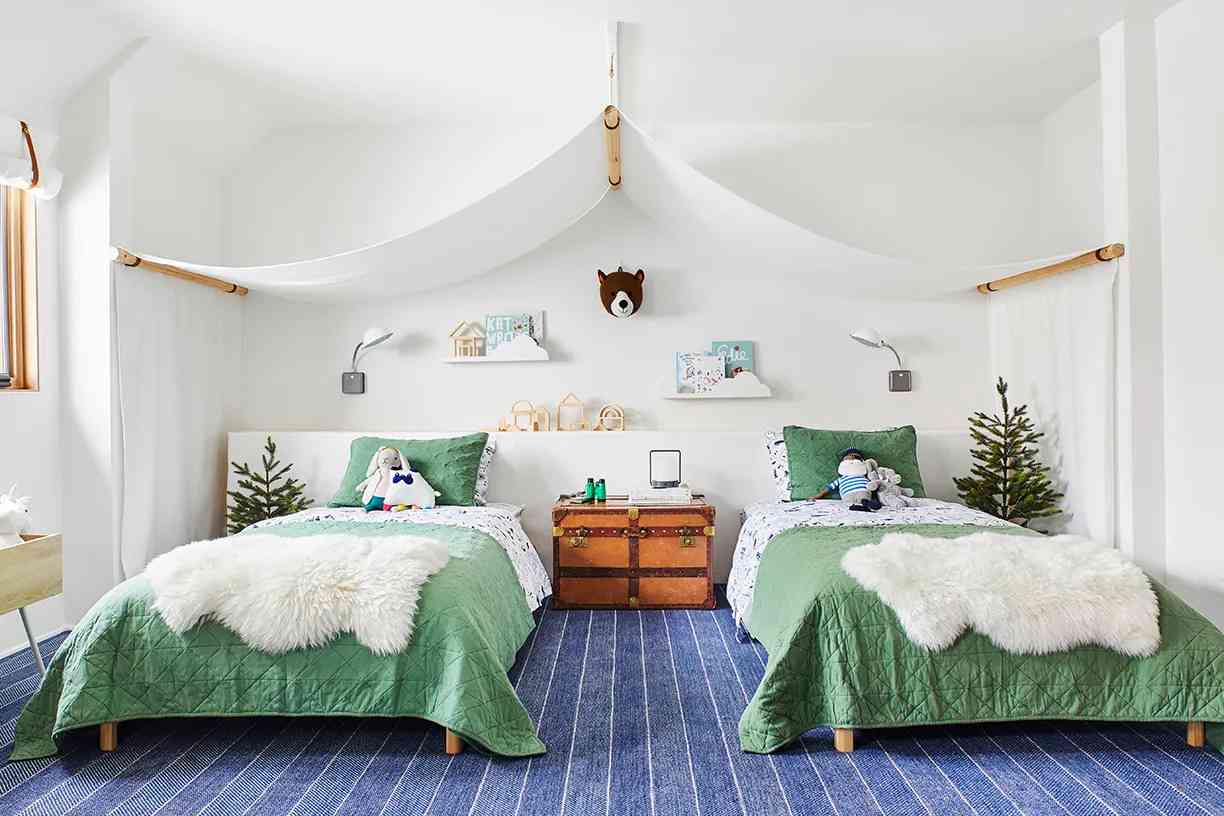
So today we’re talking about something that’s super relevant in my life right now—shared bedrooms for siblings.
I know, I know. It can feel like a lot.
You’ve got two kids, maybe different ages, different interests, and you’re supposed to make one room work for both of them? Yeah. Been there.
But here’s what I’ve learned after years of covering celebrity homes and real family spaces: a shared bedroom can actually be pretty amazing.
Not just for saving space, but for building relationships.
My kids share a room, and honestly? Some of my favorite moments have come from overhearing their little late-night conversations.
Today I’m going to walk you through eight ideas that’ll help you design a shared bedroom that works. Not perfect. Just works. Because that’s what we’re aiming for here.
8 Bedroom Ideas For Siblings
Why a Shared Bedroom Can Be a Positive Experience
Okay so first off, let’s talk about why this isn’t just something you’re doing because you don’t have enough bedrooms. There’s real value here.
When siblings share a room, they learn negotiation skills.
They figure out how to coexist. And yeah, they fight sometimes—but they also create this bond that’s hard to replicate when everyone has their own space.
I remember interviewing a family for a piece a few years back.
Three kids, two bedrooms.
The mom told me her older two shared until they were teenagers, and even after they got separate rooms, they still preferred hanging out together. That stuck with me.
The practical side matters too.
Shared rooms mean more space elsewhere in your home.
Maybe you get a playroom, or a home office, or just a living room that isn’t overrun with toys.
But the emotional part? That’s what really sells it for me.
Kids who share rooms often report feeling less lonely at night. They have a built-in buddy. And in a world where screen time keeps creeping up, having someone physically present in your space creates natural opportunities for conversation and play.
Key Factors to Consider Before Designing a Shared Bedroom
Before you start rearranging furniture or painting walls, you need to think through a few things.
Age gap matters. A lot. Two kids who are both under five? That’s easier than a teenager sharing with a seven-year-old.
The sleep schedules alone will make you want to pull your hair out. If you’ve got a big age difference, you’ll need to plan for different bedtimes, different privacy needs, and different noise tolerance levels.
Room floor size is obvious but worth stating.
A tiny 10×10 room for two kids is going to require very different solutions than a spacious 14×16 space. Measure your room. Actually measure it. Don’t guess.
Personality types. This is huge. Do you have two introverts who need alone time? Or one extrovert and one kid who just wants peace and quiet? Understanding how your kids recharge will shape every decision you make about the space.
Also think about storage needs right now.
Not in a year, not when they’re older. Right now. Because if you don’t have enough places to put their stuff today, the room will be chaos by next week.
Space-Saving Layout Ideas for Shared Bedrooms
Let me tell you about the biggest mistake I see: pushing both beds against opposite walls and calling it done. Sure, it works. But you’re probably wasting space.
Bunk beds are the obvious choice, and honestly? They’re popular for good reason.
Parents often choose kids’ bunk beds because they combine sleeping and storage, with a play or study space tucked under the bed itself. That vertical real estate is gold when you’re working with limited square footage.
But if bunk beds aren’t your thing, try an L-shaped layout. Put one bed along one wall, the other bed perpendicular on the adjacent wall.
This creates a natural corner space in the middle that works great for a small reading nook or toy area.
Another option I’ve seen work really well: parallel beds with a shared nightstand in between.
It creates symmetry, saves space, and gives both kids equal access to a lamp or their water bottle at night.
And here’s something I did in my own kids’ room—I moved the beds away from the walls entirely.
Sounds counterintuitive, right? But creating a little walkway behind the beds freed up the wall space for a long low bookshelf that both kids can reach. Changed everything.
Creating Personal Space in a Shared Bedroom
This is where things get tricky. Two kids, one room. How do you give them each a sense of ownership?
Start with the bed itself. Let each kid pick their own sheets or pillowcase.
My daughter has unicorns, my son has dinosaurs.
Do they match? Not even a little. But I throw neutral quilts over everything, and suddenly it looks intentional instead of chaotic.
Bed curtains are genius if you can swing it.
Hang a curtain rod above each bed with a simple fabric panel.
Kids can pull them closed when they want privacy or leave them open when they’re feeling social. It’s like having a temporary fort that’s always available.
Designated zones help too.
Even if you can’t put up physical dividers, you can create invisible boundaries. One side of the room has a blue rug, the other has green.
One kid’s stuff goes on the left bookshelf, the other’s on the right. Kids understand territories better than we give them credit for.
Personal wall space matters more than you’d think.
Give each child a small bulletin board or a section of wall where they can hang their artwork, photos, or whatever makes them happy. That sense of “this is mine” goes a long way in a shared environment.
Shared Bedroom Ideas for Different Age Groups
The age of your kids completely changes your approach.
For toddlers and preschoolers (ages 2-5), keep it simple.
They don’t need much personal space yet. Focus on toy storage that’s easy to access and safe furniture with no sharp edges.
These little ones are still learning to share everything, so the room itself being shared isn’t a big deal yet.
Elementary age kids (ages 6-10) start needing more independence. This is when you want to create those personal zones I mentioned earlier.
They’re old enough to have homework (okay I won’t use that word), to have hobbies, to want some control over their environment.
Give them input on room design. Let them help choose paint colors or where furniture goes.
Mixed ages get complicated. If you’ve got a teen sharing with a younger sibling, you need to prioritize the older kid’s need for privacy and quiet.
Put the younger child’s bed closer to the door so the older one has a back corner that feels more separate.
Use room dividers—actual physical ones like a bookshelf or a curtain—to create distinct areas.
Shared Bedroom Ideas for Brothers, Sisters, and Mixed-Gender Siblings
Two brothers or two sisters are usually the easiest setup. You can lean into themes they both enjoy or keep things totally neutral.
For brothers, I’ve seen rooms done up with space themes, nature themes, sports themes. Or honestly, just clean and simple with pops of their favorite colors.
The key is getting their buy-in. Don’t force a theme they don’t care about just because it looks good on Pinterest.
Sisters’ rooms can go the same way.
Maybe they both love animals, or books, or art. Build the room around that shared interest. But also, don’t assume all girls want pink and purple.
I’ve designed rooms for sisters who wanted gray and yellow, navy and coral, or just straight-up white everything.
Mixed-gender siblings need the most thought.
Privacy becomes more important as they get older.
Under age seven or eight, it’s usually fine to treat it like any other shared room.
After that, you want to start planning for eventual separate spaces or at least very defined personal areas.
Color schemes for mixed-gender rooms should stay pretty neutral.
Grays, whites, beiges, soft greens or blues. Then let each kid add their personality through bedding, pillows, and wall decorations on their side.
Storage Solutions for Shared Bedrooms
Listen. If your storage game is weak, the room will be a disaster. I don’t care how cute you make it.
Under-bed storage is your best friend.
Get beds that are raised high enough for rolling bins underneath.
Put off-season clothes in there, extra blankets, toys they don’t use daily. Out of sight but still accessible.
Closet organization deserves its own attention.
Hang as much as you can. Seriously. I used to stuff everything into drawers, and it was a nightmare.
Once I started hanging shirts, dresses, even some pants, I freed up so much drawer space. Color-code it if you want to get fancy, or just separate by child.
Cubby storage is a lifesaver. I put a cubby organizer in my kids’ closet, right on the floor where there was just wasted space.
Now we have nine cubes for organizing toys, shoes, books, whatever. The kids can see everything, grab what they want, and (theoretically) put it back.
Use clear bins for small stuff like building blocks or craft supplies.
Upholstered bins work great for bigger items that don’t look neat—stuffed animals, dress-up clothes, action figures. Everything has a home, and the room stays manageable.
Wall-mounted storage is underrated. Floating shelves, pegboards, wall hooks.
Get stuff off the floor and onto the walls. It makes the room feel bigger and gives you more functional space.
Color Schemes and Decor Ideas That Work for Two
Paint the walls neutral. I’m serious. Soft gray, warm beige, crisp white.
This gives you flexibility and makes the room feel bigger and brighter. Let the kids add color through their stuff—bedding, artwork, rugs.
Accent walls can work if you want something bolder, but keep it a color both kids can live with. Sage green, dusty blue, even a soft terracotta.
Avoid anything too babyish or too mature unless your kids are the same age and stage.
Matching furniture creates visual calm even when the room is full of toys and clothes. Same bed frames, same dressers, same nightstands.
It pulls everything together without looking too matchy-matchy.
Personal touches make the space feel lived-in and loved.
Photos from family trips, their favorite books displayed on a shelf, a lamp one of them picked out.
These details matter because they make the room feel like it belongs to your kids, not like it came straight from a catalog.
Themes that appeal to both kids are ideal but not required.
Animals work great—everybody loves animals.
Nature scenes, maps, simple geometric patterns. Or skip the theme entirely and just keep things clean and simple.
Conclusion
Alright. Here’s what I want you to take away from all this.
Shared bedrooms for siblings aren’t something to stress about.
They’re an opportunity. An opportunity to teach your kids about compromise, about respecting each other’s space, about being together even when it’s not always easy.
Start with the basics—figure out your layout, maximize your storage, keep your color scheme flexible.
Then add the personal touches that make your kids feel seen and heard. Their sheets, their artwork, their little collections of whatever they’re into right now.
And remember, it doesn’t have to be perfect. My kids’ room? There’s usually at least one bin of toys dumped out somewhere.
Someone’s shoes are probably in the middle of the floor. But it works. They’re happy there. They play there, sleep there, grow there.
That’s what matters. Create a space that functions for your family right now, knowing it’ll change as your kids change. And try to enjoy this phase, because one day they’ll want separate rooms and you’ll probably miss the chaos just a little bit.