Stone benchtops. They’re everywhere in Australian homes right now and for good reason.
As someone who’s been writing about interior design and celebrity homes for over 15 years, I’ve seen trends come and go. But stone? Stone stays.
There’s something about natural stone surfaces that just works in a kitchen or bathroom.
They’re durable, they look expensive even when they’re not, and they age in a way that feels earned rather than worn out.
This comprehensive guide explains what Stone Benchtops are, the different types available in Australia, their benefits, potential drawbacks, and how to choose the right option for your home.
But here’s what I’ve noticed—most homeowners don’t actually know what they’re getting when they choose stone.
They see a pretty slab at the showroom and think “yep, that’s the one” without understanding what that decision means for the next 20 years. So let’s fix that.
9 Complete Homeowner’s Guide About Stone Benchtops
What Is a Stone Benchtop?
A stone benchtop is basically a work surface made from—you guessed it—stone. But it’s not that simple.
Stone benchtops can be made from natural stone that’s quarried straight from the earth. Think marble, granite, quartzite. These are the real deal.
They were formed over millions of years through geological processes that I won’t bore you with because honestly who cares about sedimentary this and metamorphic that when you just want a nice kitchen.
Then you’ve got engineered stone.
This is where manufacturers take natural stone pieces—usually quartz crystals—and bind them with resin to create slabs. It’s still stone. Just assembled differently.
The benchtop itself is usually 20mm or 30mm thick.
Sometimes thicker if you’re going for that chunky look. It gets cut to fit your space, edges get finished, holes get cut for your sink and cooktop, and boom. You’ve got a stone benchtop.
Types of Stone Benchtops
There are really two main camps here.
Natural stone benchtops are cut directly from quarried stone blocks. Each slab is unique because nature doesn’t do copies.
The veining, the color variations, the little imperfections—they’re all part of what you’re buying. You can’t order another piece that looks exactly the same if you need more later. What you see is what you get.
Engineered stone benchtops are manufactured. They take crushed stone (usually around 90-95% quartz) and mix it with polymer resins and pigments.
This means they can control the final look. Want consistent color? Done. Want a specific pattern repeated? No problem. It’s stone, but with a lot more predictability.
Some people get weird about engineered stone being “fake.” It’s not fake. It’s just made differently. Like comparing a wild salmon to a farmed one—both are still salmon, just raised in different environments.
Popular Stone Materials Used for Benchtops
Let’s talk about what’s actually being installed in Australian homes.
Granite was huge in the 2000s and early 2010s. Natural stone, extremely hard, and it comes in these speckled patterns with flecks of different minerals.
It’s durable as hell. Heat resistant. Scratch resistant. But it can look dated now depending on the color you choose.
Those busy multicolor granites? Yeah, they’re showing their age.
Marble is the fancy one. White marble with gray veining is what everyone pictures when they think luxury kitchen. It’s softer than granite, which means it scratches and stains easier. Coffee, wine, lemon juice—they’ll etch the surface. But people still want it because it’s beautiful and it has this depth that engineered stones struggle to replicate.
Quartz (engineered) has taken over the market. It’s low maintenance, comes in endless colors and patterns, and it’s consistent. You can get it to look like marble without the maintenance headaches. Australian brands like Caesarstone and Essastone are massive here. It’s non-porous so bacteria and stains don’t penetrate. But heat can damage it since there’s resin involved.
Quartzite confuses people because the name sounds like quartz but it’s completely different. This is natural stone—a metamorphic rock that’s harder than granite. It looks similar to marble, often with similar veining, but it’s tougher. It costs more too.
Porcelain slabs are the new kid. They’re not technically stone but they’re competing in the same space. Ultra-thin, printed with realistic stone patterns, heat resistant, and they can be huge slabs with minimal seams. The edges give them away though—you can see it’s a printed surface once you look at the profile.
How Stone Benchtops Are Made
Natural stone starts at a quarry. Huge blocks get cut out of the earth using diamond wire saws. These blocks then get sliced into slabs—usually 2cm or 3cm thick.
The slabs get polished, finished, and shipped to distributors.
When you order one, a fabricator comes to your home, measures your space down to the millimeter, and creates a template.
That template goes back to their workshop where they cut your slab using CNC machines or water jets.
They cut out the sink holes, shape the edges, polish everything, and then install it in your home using structural adhesive.
Engineered stone follows a different path. Manufacturers mix quartz aggregate with resin (about 7-10% resin to 90-93% quartz).
They add pigments for color. The mixture gets poured into molds, then vibrated to remove air bubbles, and compressed under intense pressure in a vacuum.
After that it’s cured, sometimes with heat. Then it gets polished and finished just like natural stone.
The fabrication process from that point is the same—templating, cutting, installing.
Key Benefits of Stone Benchtops
Why do people keep choosing stone? Because it works.
Durability is obvious. Stone benchtops last decades. I’ve seen 30-year-old granite counters that still look decent. You’re not replacing these every renovation cycle.
They handle heat better than most alternatives.
Not all stone equally—engineered quartz can scorch—but natural stones like granite let you put a hot pot down without panicking.
Should you still use a trivet? Yes. But if you forget once, you’re probably fine.
Scratch resistance is real. Knives won’t easily scratch granite or quartzite.
Quartz is pretty tough too. You can work directly on the surface without babying it constantly.
They’re hygienic. Engineered stone especially, since it’s non-porous.
Bacteria can’t penetrate the surface. Natural stones need sealing to get that same protection, but once sealed, they’re just as clean.
Resale value. Buyers expect stone benchtops now, especially in kitchens. It’s become a baseline expectation in mid-to-upper price brackets.
You might not recoup the full cost, but you’ll hurt your sale if you don’t have it.
Aesthetics matter too. Stone just looks expensive. Even when it’s not. There’s a visual weight to it that laminate and other materials can’t match.
Stone Benchtops vs Other Benchtop Materials
Let’s get real about the alternatives.
Laminate is cheap and comes in a million patterns. But it chips, it burns, it swells if water gets underneath, and everyone knows it’s laminate.
Fine for a rental or budget reno. Not fine if you’re trying to create something that lasts.
Timber benchtops look warm and beautiful. They age with character. But they need oiling, they can stain, they scratch easily, and water damage is a real concern around sinks.
They work in certain aesthetics—Scandi, country, rustic—but they’re high maintenance.
Stainless steel is commercial-grade tough. Hygienic, heat-proof, waterproof. But it scratches, it shows fingerprints, and it feels cold. Literally and aesthetically.
Most homes can’t pull this off unless you’re going full industrial.
Concrete had a moment. Custom colors, seamless designs, modern industrial feel. But it’s porous, needs sealing, can crack, and it’s heavy.
Installation costs are high because it often gets poured on-site.
Stone sits in this sweet spot. It’s durable enough for real use, beautiful enough that you want to look at it, and available at multiple price points depending on which type you choose.
Best Areas in the Home for Stone Benchtops
Kitchens are the obvious choice. This is where stone benchtops make the most sense. You’re dealing with heat, water, food prep, dropped objects, and heavy use. Stone handles all of it.
Bathrooms work well too. Vanity tops in stone feel luxurious.
They’re waterproof once sealed (or naturally waterproof with engineered stone), easy to clean, and they don’t warp or swell like timber alternatives.
Laundries are underrated spaces for stone. You need a durable surface that can handle detergent spills, wet clothes, and maybe some stain treatment.
Stone works. It’s overkill for some people’s budgets, but if you’re already doing stone elsewhere, carrying it into the laundry creates consistency.
Outdoor kitchens and BBQ areas need careful selection. Not all stone works outside. Granite is fine. Quartzite is fine. Engineered quartz with resin? Not great—UV exposure can discolor it over time. Porcelain actually works brilliantly outdoors because it’s UV-stable and weather-resistant.
Bar areas and butler’s pantries are spots where stone makes sense if you’re already installing it in the main kitchen.
Carrying the same material through creates flow. Though you can also use this as a chance to introduce a different stone—maybe marble in the butler’s pantry for that fancy moment.
How to Choose the Right Stone Benchtop for Your Home
This is where people overthink things or don’t think enough.
Start with your lifestyle. Do you actually cook? Do you have kids who’ll spill everything? Are you precious about maintenance? If you’re busy and don’t want to think about your benchtop, engineered quartz makes sense.
If you love the ritual of caring for things and want that natural stone character, go granite or marble.
Color choice matters more than you think. Light colors show less dirt but can stain more obviously (especially marble).
Dark colors show every water spot and fingerprint but hide stains better.
Medium tones split the difference. Also consider your cabinet color—you want contrast or tonal harmony, not everything blending into beige soup.
Edge profiles seem minor but they change the whole look. A simple square edge feels modern. A bullnose edge feels softer, maybe dated depending on how pronounced it is.
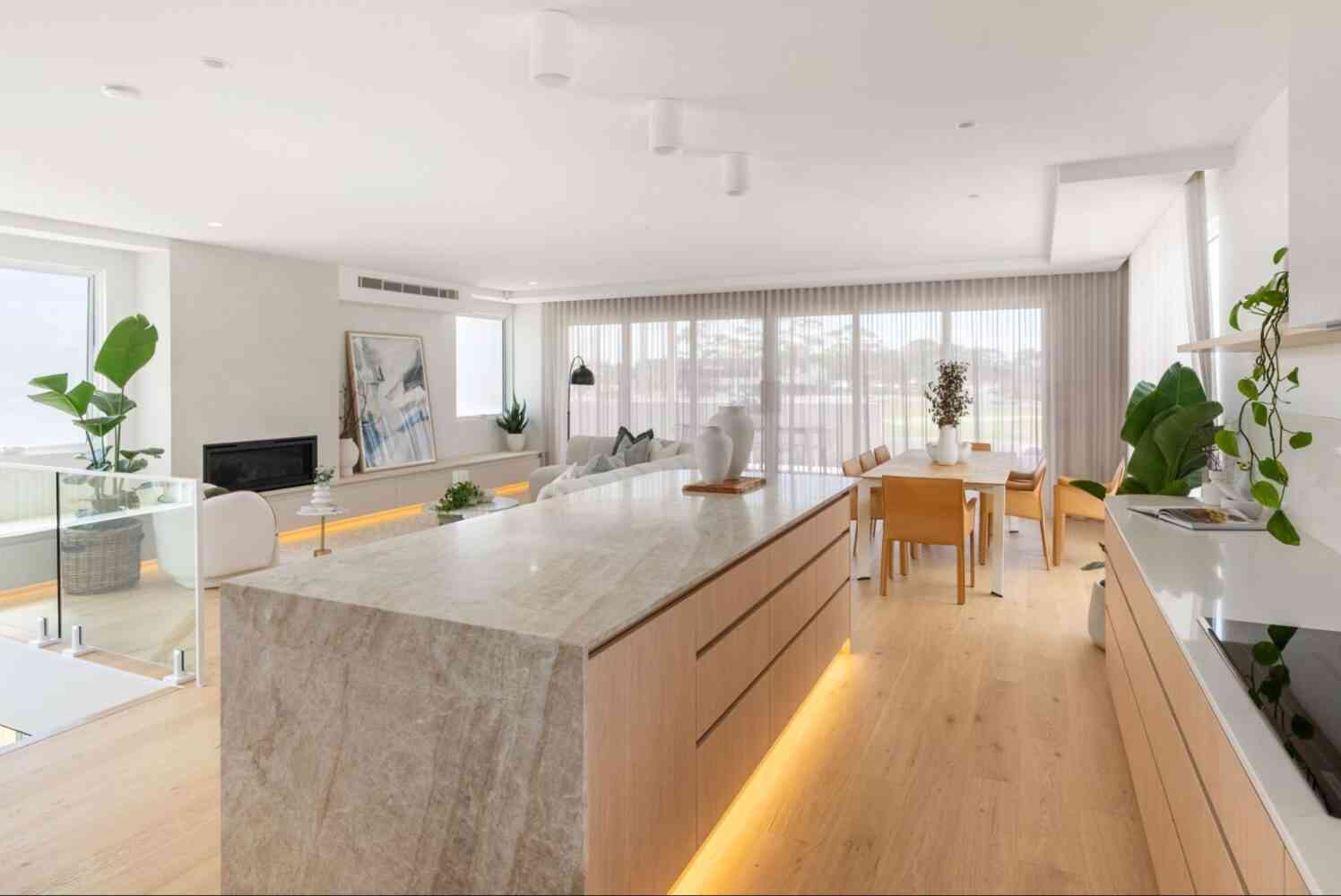
Waterfall edges (where the stone continues down the side of cabinets) are trendy right now but they eat up material fast, which means higher cost.
Thickness affects price and aesthetic. 20mm is standard and fine.
30mm feels more substantial. Some people double up thickness at the edge to make a 20mm slab look like 40mm—gets you the look without the full material cost.
Veining and pattern intensity is personal. Some people want dramatic veining with movement. Others want subtle consistency.
Look at the full slab before fabrication if you can, especially with natural stone. That little sample in the showroom might not represent what a 3-meter run actually looks like.
Budget reality check. Laminate to stone is a massive jump. But within stone, the range is wide. Basic granite or engineered quartz might be $400-600 per square meter installed.
Premium marble or quartzite could be $800-1200+. Set your budget first, then see what’s possible.
Get multiple quotes. Fabricators vary wildly on price. Same stone, different fabricator, $2000 difference in total cost. Not joking.
Stone Benchtop Maintenance and Care
Natural stone needs sealing. How often depends on the stone and the sealer. Granite might need it yearly. Marble might need it every 6-12 months.
Quartzite annually. You can test it by dropping water on the surface—if it beads up, you’re good. If it darkens the stone, time to reseal.
Sealing isn’t complicated. Buy the sealer, wipe it on, let it sit, wipe it off. It takes maybe 20 minutes.
Daily cleaning is just soap and water. Don’t use anything acidic on marble—no vinegar, no lemon-based cleaners. They’ll etch the surface. Stick to pH-neutral cleaners.
Engineered quartz doesn’t need sealing. Clean it with regular dish soap and water. Avoid harsh chemicals and bleach which can damage the resin over time. Don’t use abrasive scrubbers.
Spills should get wiped up reasonably quickly. Not immediately—you can finish your glass of wine—but don’t let red wine sit on marble overnight.
Heat protection is smart even on heat-resistant stone. Trivets and hot pads cost $20. A replacement benchtop costs thousands. Use the trivets.
Cutting boards protect your knives more than your benchtop honestly. But they prevent scratches on polished surfaces too. Just use them.
That’s it. Stone benchtops aren’t precious objects that require constant attention. They just need basic respect and occasional maintenance.
Conclusion
Stone benchtops are popular in Australia for good reason—they’re durable, beautiful, and practical for real life. Natural stone gives you a unique character and that one-of-a-kind factor.
Engineered stone gives you consistency and lower maintenance. Both have their place depending on what you value.
The choice comes down to your budget, how much maintenance you’re willing to do, and honestly what look you’re trying to create.
There’s no wrong answer here. Just different priorities.
If you’re renovating or building, stone benchtops are worth the investment in kitchens and bathrooms.
They’ll outlast most other elements in those spaces. And when you eventually sell, buyers expect to see them.
Pick something you like looking at.
Something that fits how you actually live. And don’t stress too much about trends—stone has been used for thousands of years. It’s not going anywhere.