

Life’s beauty lies in its unpredictability, but it’s not always gentle about it.
Sometimes you wake up with a normal day ahead, and by noon, you’re staring at the reality of a move you didn’t plan for.
If you’re in that spot right now, take a breath.
You’re not as stuck as you feel. A 24-hour move is tight, but you can tackle it with a clear plan and quick action.
You’ll move faster once you know what to focus on first, what you can skip, and where outside help fits in.
This is also the moment to consider whether calling emergency movers makes sense, especially if you’re short on hands or time.
Keep reading to see the steps that help you regain control, even on a deadline this sharp.
Set Your Priorities Within the First Hour
When the clock is tight, you need a clear starting point.
Start by sorting your day into three simple groups:
- must-take items
- nice-to-have items
- things you can leave behind without a second thought
Focus on the first group.
These are the items you rely on every day — medication, chargers, work gear, personal documents, and anything tied to daily comfort.
Place them in one spot so you’re not hunting for them later.
Next, choose what can wait.
Anything you haven’t used in months can fall into the “leave” or “donate” pile. You don’t want a large number of boxes you’ll deal with later.
If something requires extra hands or special tools, decide whether it’s worth the effort today.
Handle the Fast Packing Stage
Smart packing choices can help you keep the momentum, so it’s time to put speed over perfect order.
Create Simple Item Groups
Keep this part easy on yourself.
Group items by purpose, not by room. Daily-use gear in one box, toiletries in another, work essentials in a third.
Skip the slow sorting you’d usually do.
Your goal is to keep related items together so you can unpack without frustration later.
Clear Each Room Quickly
Move through each room with one rule: take what matters, leave what doesn’t.
Don’t set anything aside “for later.” Later doesn’t exist in a 24-hour move.
Carry a large trash bag and a box with you.
If it’s trash, it goes straight in the bag. If it’s coming with you, it goes straight in the box.
Secure Important Documents
Put passports, IDs, medical details, banking info, and work files in one folder you keep with you.
These items slow you down the most when lost, so keep them in a separate bag that never leaves your sight.
This single step removes a huge amount of stress once you’re on the road.
Bring in Help You Can Count On
Who wants to handle a last-minute move alone? If you can find support, do it.
Whether you’re in one of the most populous states, such as California, Texas, or Florida, or somewhere less crowded, think of anyone who can give you immediate help.
A neighbor, a friend who lives close, or a relative who can spare an hour can speed up your progress more than you think.
If no one is free, call a professional service that handles last-minute jobs.
Many companies keep openings for short-notice calls, which is helpful when you need fast pickup and transport.
Look at the basics: availability, time window, and whether they can handle any bulky items you decided to keep.
While you’re comparing options, try to keep rough costs in mind so nothing catches you off guard.
A 2025 survey shows that the average move runs around $3,020.
Local moves land closer to $1,489, while long-distance ones hover near $3,124.
Once you decide who’s backing you up, plan the next hour with them in mind.
List the rooms or tasks they can jump into right away!
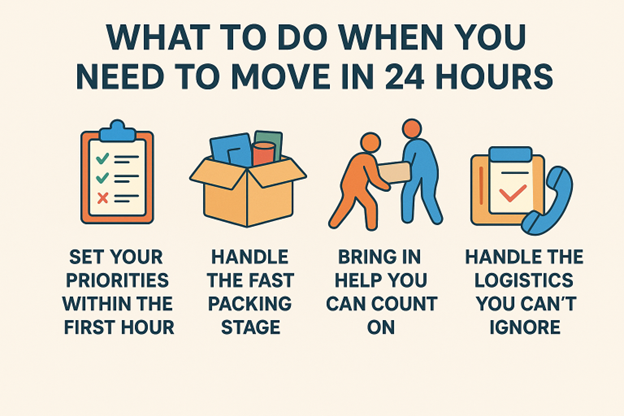
Handle the Logistics You Can’t Ignore
This part isn’t exciting, but it protects you from headaches once you’re out the door.
First of all: utilities.
Call your providers and request immediate shutoff or transfer.
Most companies can process same-day changes if you explain the situation.
Do the same for your internet and any subscription services tied to your address.
Next, update the places that rely on your correct details.
Change your address with your bank, workplace, medical offices, and any other service you use often.
Even a short message or online form keeps your information clean and prevents delays on important mail.
If you’re leaving a property behind, think about where it stands from a timing point of view.
Maybe you already listed it, or maybe you’re preparing a home sale soon.
Either way, leave the space in a condition that prevents issues with agents, landlords, or buyers.
Finally, don’t forget about that small bag with essentials for the next 24 hours.
Clothes, toiletries, keys, chargers, and anything you need the moment you arrive.
You don’t want to dig through boxes when you’re tired and still settling in.
Your Move, Your Reset Point
A 24-hour move is one of those circumstances that forces you to act before you feel ready, and that’s where your strength shows.
You made decisions within minutes, cleared space faster than you expected, and kept your focus sharp when the clock refused to slow down — give yourself credit for that.
You handled a situation that demands grit, and you did it under pressure that most people never face.
The day may have been rushed, but your next steps don’t have to follow that same pace.