
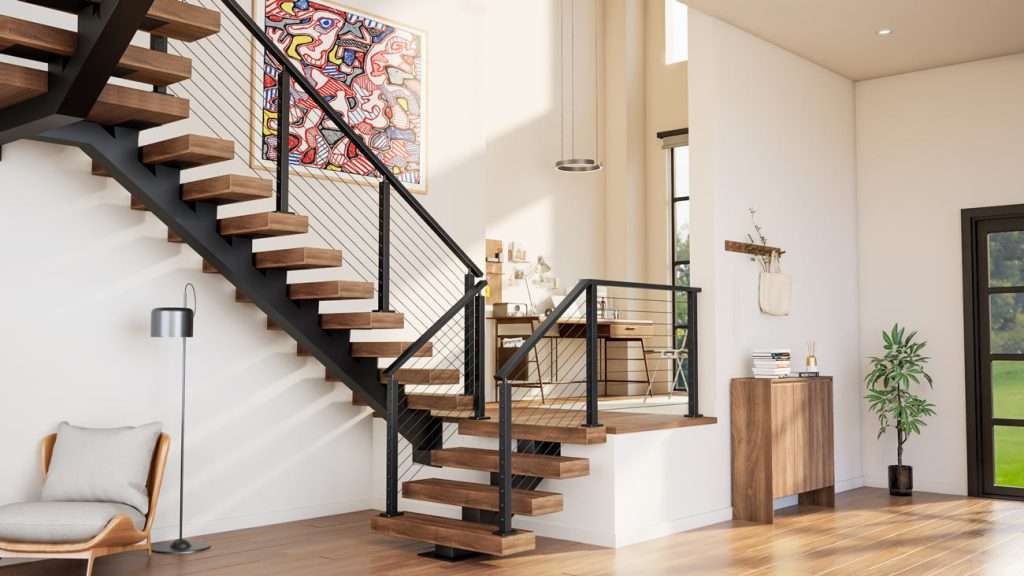
Okay, so we need to talk about floating stairs and glass walls because I see these everywhere on Pinterest and Instagram and honestly? They’re stunning. But here’s the thing – a lot of people think these are just pretty design choices that magically happen, and they don’t really understand what’s actually going on behind the scenes to make them work.
And i get it. You see this beautiful home with these stairs that look like they’re defying gravity, paired with these massive glass panels, and you think “i want that” but you probably don’t think about the engineering.
Which, fair enough, most people don’t. But if you’re actually considering installing these in your home or you’re just curious about how they work, you really should understand what makes them possible.
So that’s what we’re doing today.
We’re breaking down the actual engineering, the real technical stuff, but don’t worry – i’m going to explain it in a way that makes sense.
No overly technical jargon that’s going to make your eyes glaze over.
How Floating Stairs And Glass Walls Work Behind Your Favorite Pinterest Pins
What Are Floating Stairs?
Okay, let’s start with the basics. Floating stairs are basically stairs that look like they’re suspended in mid-air.
There’s no visible support underneath them, no risers connecting each step. Just these individual treads – that’s the part you step on – appearing to float.
Now, they don’t actually float, obviously. That would be magic, not engineering. But the whole design is meant to create this really clean, minimalist, airy look.
The supports are hidden, usually mounted into the wall or using a super minimal central spine that you barely notice.
You’ve probably seen them in modern homes, lofts, those really high-end celebrity houses.
They’re a statement piece, right? They make a space feel open, light, and honestly kind of luxurious.
Engineering Principles Behind Floating Stairs
Here’s where it gets interesting.
So how do these things actually work without collapsing under your weight?
The main principle is cantilever support. Okay, stay with me.
A cantilever is basically a beam that’s only supported on one end. Think of it like a diving board – it’s anchored at one end and sticks out freely at the other. That’s what’s happening with floating stairs, except the anchor point is hidden inside your wall.
Each step needs to be attached to a really strong structural element.
We’re talking steel beams, reinforced concrete walls, heavy-duty mounting systems.
The wall itself has to be load-bearing – you can’t just slap these onto drywall and hope for the best. That would be a disaster waiting to happen.
The treads themselves? Usually made from thick hardwood, steel, or sometimes reinforced glass.
They need to be strong enough to handle not just your weight but the dynamic load – that’s the force created when you’re walking up and down, which is actually more stress than just standing still.
There’s also this thing called moment arm calculation.
Basically, the longer the tread extends from the wall, the more force it exerts at the mounting point.
So engineers have to calculate exactly how much reinforcement is needed based on the span, the material, and the expected load. It’s a lot of math.
Contact us today! At ProStruct, we are ready to bring your visions to life with our cutting-edge solutions in structural engineering – because honestly, this isn’t a DIY project.
Building codes come into play too. Most places require stairs to support at least 300 pounds per square foot.
Some jurisdictions want even more for commercial spaces. And there are requirements for deflection – that’s how much the stair can bend when you step on it.
You don’t want stairs that bounce like a diving board, even if that’s the engineering principle we’re using.
What Are Glass Walls?
Alright, moving on to glass walls.
These are exactly what they sound like – large panels of glass used as walls instead of traditional materials like drywall or brick.
But we’re not talking about your regular window glass here.
These are serious structural glass systems. Floor-to-ceiling panels, sometimes with minimal framing, sometimes completely frameless.
They’re used to create divisions in a space while keeping sightlines open.
You see them a lot paired with floating stairs because they both share that same design philosophy. Openness. Light. Visual continuity.
They make small spaces feel bigger and big spaces feel, i don’t know, more grand?
Engineering Behind Glass Walls
So here’s what most people don’t realize – glass walls are actually engineered systems, not just big windows stuck in place.
The glass itself is usually tempered or laminated.
Tempered glass is heat-treated to make it way stronger than regular glass, and if it breaks, it shatters into small relatively harmless pieces instead of big dangerous shards.
Laminated glass is multiple layers bonded together with a plastic interlayer, kind of like a windshield. If it cracks, the pieces stay stuck to that middle layer.
For really large installations, you might see tempered laminated glass. That’s both processes combined for maximum strength and safety.
Thickness matters a lot. We’re typically looking at glass that’s anywhere from half an inch to over an inch thick, depending on the size of the panel and what it needs to support.
Bigger panels need thicker glass, and if the glass is load-bearing – like if it’s actually holding up part of the structure – you need even more thickness.
The mounting systems are super important too.
Some systems use channels at the top and bottom where the glass slides in.
Others use point-fixed systems where the glass is held by special hardware at specific points.
There are also U-channel systems, patch fittings, all kinds of options.
And then there’s lateral load resistance. That’s engineer-speak for “can this thing handle wind, earthquakes, or someone accidentally walking into it?” The glass and the framing system have to work together to resist these forces without cracking or pulling away from the mounts.
Integration of Floating Stairs with Glass Walls
Okay, so when you combine these two elements – floating stairs and glass walls – things get really interesting from an engineering perspective.
A lot of times, you’ll see glass used as a railing system for floating stairs.
Makes sense, right? You want to maintain that open, airy feeling, so instead of a solid wood or metal railing, you use clear glass panels.
But here’s the catch – those glass railings have to meet really strict building codes.
In most places, railings need to withstand a concentrated load of 200 pounds applied at the top. That means someone could lean on it, push against it, and it shouldn’t budge or break.
The glass panels for railings are usually tempered, and they need to be thick enough and mounted securely enough to handle that force.
You’ll often see them mounted into the treads themselves using special channels or clamps.
Sometimes the glass wall becomes part of the stair structure.
Like, you might have stairs cantilevered from one side and a glass panel on the other side that’s also providing some structural support.
That requires really careful engineering because now you’re asking the glass to do more than just sit there looking pretty.
Thermal expansion is another consideration people forget about.
Glass and steel and wood all expand and contract at different rates when temperature changes.
The mounting systems have to allow for that movement or you end up with cracks and failures.
Challenges in Design and Installation
Oh boy, where do i start with the challenges? Because there are a lot.
First up – building codes and permits. This is probably the least fun part but it’s super important.
Every jurisdiction has different requirements, and some places are way more strict about floating stairs and glass walls than others.
You need engineering drawings, structural calculations, permits, inspections. The whole nine yards.
Structural capacity of the existing building is a big one.
If you’re retrofitting floating stairs into an existing home, you might find out that your walls aren’t strong enough to support them. That means reinforcement, which means opening up walls, adding steel beams, making a mess. It’s not always a simple swap.
Installation precision is critical.
We’re talking millimeter-level accuracy here.
If the mounting points aren’t perfectly aligned, the stairs won’t line up properly.
If the glass panels are even slightly off, they won’t fit or they’ll be under stress that could cause cracking.
Weight is another issue people underestimate.
Glass is heavy. Really heavy.
A large floor-to-ceiling glass panel can weigh several hundred pounds.
You need the right equipment to move it, position it, and install it safely. And once it’s in place, the structure needs to support that weight long-term.
Cost tends to surprise people too. These aren’t budget-friendly options.
The materials are expensive, the engineering is expensive, the installation is expensive. You’re looking at significantly more than traditional stairs and walls.
And here’s something that doesn’t get talked about enough – maintenance and cleaning.
Glass shows every fingerprint, smudge, and streak. You’ve got these beautiful clear panels and suddenly you’re cleaning them every other day.
Floating stairs with open treads mean dust and debris can fall through. Just something to think about.
Pros and Cons of Floating Stairs & Glass Walls
Let’s get real about the good and the bad, because there’s definitely both.
Pros first, because i do love these design elements when they’re done right.
The aesthetic is incredible.
Nothing makes a space feel more modern, more open, more high-end than well-executed floating stairs and glass walls. They’re showstoppers.
The light flow is amazing too. Glass doesn’t block natural light, so you can maintain brightness throughout your space.
In smaller homes or apartments, that openness can make the space feel way bigger than it actually is.
There’s also this flexibility in design.
You can customize the materials, the dimensions, the finishes.
Wood treads, steel treads, glass treads. Brushed metal, polished, matte. Frameless glass, minimal framing, whatever works for your space.
Now the cons, because we need to be honest.
Safety concerns are real. Open treads on floating stairs can be tricky for kids, elderly people, or anyone with mobility issues.
Glass railings can be disorienting for some people. And if the glass breaks for any reason, that’s a serious hazard until it’s replaced.
The cost, like i mentioned earlier.
You’re going to pay a premium for these features. Not just installation but also if anything needs repair down the line.
Privacy can be an issue with glass walls.
Sure, you can use frosted or tinted glass, but then you lose some of that openness and light that’s the whole point.
Sound transmission is worse with glass than with solid walls.
If you’re using glass walls to divide spaces, sound is going to carry right through.
And structural limitations mean these aren’t possible in every building.
Older homes, buildings with certain construction types, places where you can’t modify the structure enough – sometimes it’s just not feasible.
Conclusion
So there you have it. The real engineering behind those gorgeous Pinterest-worthy floating stairs and glass walls.
Look, are they beautiful? Absolutely. Are they worth considering for your home? Maybe, depending on your budget, your building, and your lifestyle. But now you know what’s actually involved in making them happen.
It’s not just about aesthetics – there’s serious structural engineering, careful planning, and skilled installation behind every one of those stunning photos you see online.
If you’re seriously thinking about this for your space, talk to a structural engineer first. Get the building assessed.
Understand what’s possible and what’s not. Because the last thing you want is to fall in love with an idea that’s not feasible for your situation, or worse, to try to cut corners and end up with something unsafe.
These design elements are incredible when done right, but “done right” means respecting the engineering, following the codes, and working with professionals who know what they’re doing. That’s how you get from a Pinterest dream to reality.