
I’ll never forget the first time I really noticed concrete barriers.
Not just saw them—noticed them.
I was driving back from covering a story about highway redesigns, and there they were.
These massive concrete structures lining the median, and I had this moment where I thought: when did these become everywhere?
Turns out, there’s a reason for that. A really good one, actually.
Most of us drive past concrete barriers every single day without giving them a second thought. They’re just… there.
Part of the landscape. But after spending the better part of three months researching traffic management systems and talking to civil engineers who get genuinely excited about concrete (yes, those people exist), I learned something that changed how I see these structures.
They’re not just dividers. They’re silent protectors that have saved thousands of lives, and most of us have no idea how they work or why they matter.
So here’s what I want to share with you today—the real benefits of these barriers that go way beyond just keeping cars in their lanes.
8 Key Benefits Of Concrete Barriers In Traffic And Safety Management
Before we get into the specifics, let me say this: concrete barriers are one of those things that work best when you don’t notice them doing their job.
When they’re doing what they’re supposed to do, nothing happens.
No crash. No crossover collision. No worker getting hit.
The absence of disaster, that’s the whole point.
But understanding what makes them effective? That requires looking at the engineering, the design choices, and yeah, even the physics behind why a 4,000-pound chunk of concrete beats pretty much any other option out there.
Improved Vehicle Containment
Here’s what most people don’t realize about vehicle containment.
When a car hits a barrier at highway speeds, the barrier isn’t just sitting there taking the hit.
There’s this whole redirection process happening in milliseconds that determines whether that vehicle bounces back into traffic, goes over the barrier, or gets safely redirected along the barrier’s face.
Concrete barriers for traffic control, the physics are straightforward. A barrier with sufficient mass does not get pushed out of position on impact.
And that mass? That’s the secret.
I talked to a highway safety engineer in Ohio who explained it like this: “A plastic barrier filled with water might weigh 1,600 pounds.
Sounds heavy, right? But a concrete barrier section weighs 4,000 pounds.
When a 4,000-pound vehicle going 60 miles per hour hits that concrete, the barrier stays put. The vehicle gets redirected.”
The shape matters too. Most concrete barriers use what’s called a Jersey shape—that distinctive sloped profile you’ve probably seen a million times.
The lower slope catches the vehicle’s tire and wheel, and the upper slope redirects the vehicle back away from the barrier.
It works. Year after year, it just works.
Enhanced Roadside Worker Safety
I met a road crew supervisor named Mike last summer who told me something that stuck with me.
He said, “Every time we set up a work zone, I think about going home to my kids.”
That’s the reality for roadside workers. They’re out there with vehicles flying by at 50, 60, sometimes 70 miles per hour just feet away.
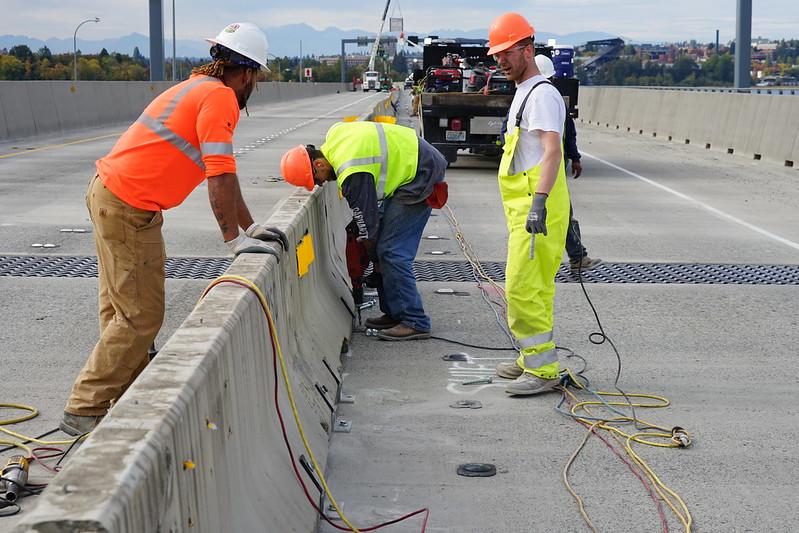
Concrete barriers create a physical shield between those workers and traffic.
Not a suggestion to drivers to slow down. Not a cone that gets hit and goes flying. A solid, immovable wall.
The numbers back this up. Work zones with concrete barrier protection see significantly fewer worker injuries compared to zones using other traffic control methods.
Actually, Mike told me about a time when a driver fell asleep at the wheel and crashed directly into the barrier protecting his crew.
The barrier held. The car didn’t make it through. Everyone on his crew went home that night.
That’s not a statistic. That’s real lives.
Long-Term Durability
One thing that surprised me during my research: concrete barriers can last 20 to 30 years with minimal maintenance.
Think about that for a second.
Most traffic control equipment needs constant replacement, repair, or attention.
Plastic barriers crack. Steel guardrails rust and need repainting. Cables fray.
Concrete? It just sits there. Rain, snow, sun, impacts—it handles all of it.
I visited a transportation department storage yard where they showed me barriers that had been in service for 15 years.
Apart from some surface staining and minor chips, they looked ready for another 15 years of service.
The concrete mix used for these barriers is engineered to withstand freeze-thaw cycles, which is critical in northern climates.
Water can’t penetrate easily, so you don’t get that expansion and cracking that destroys other materials.
There’s an economic argument here too, which brings me to the next point.
Reduced Maintenance Costs
Here’s where the math gets interesting.
Initial installation of concrete barriers costs more than many alternatives.
No question about that. But when you look at the total cost over the life of the barrier, concrete comes out way ahead.
A transportation official I spoke with in Pennsylvania broke it down: “We can buy cheaper barriers upfront, but we’ll replace them three or four times over 20 years. Or we can install concrete once and basically forget about it.”
No repainting. No rust treatment. No replacing cracked sections every few years.
The only real maintenance involves occasional cleaning and repositioning if a barrier gets hit hard enough to shift—which rarely happens because, again, mass.
When municipalities are trying to stretch already tight budgets, that long-term cost savings adds up to real money that can go toward other safety improvements.
Effective Traffic Flow Management
This benefit doesn’t get talked about enough.
Concrete barriers aren’t just safety devices.
They’re traffic management tools that give engineers flexibility to reconfigure roadways quickly.
Need to shift lanes for construction? Drop in portable concrete barriers.
Want to create a temporary median? Same solution. Need to redirect traffic around an accident scene? You get the idea.
The temporary barrier systems they use now are pretty remarkable.
They can be installed and removed relatively quickly using specialized equipment, and they provide the same level of protection as permanent installations.
I watched a crew reconfigure an entire highway lane pattern in about six hours using portable concrete barriers. That same project using permanent construction would have taken weeks and cost exponentially more.
During high-traffic events or seasonal construction projects, this flexibility becomes critical. You can’t just shut down highways for months anymore.
People need to move, goods need to get delivered.
Concrete barriers make that possible while keeping everyone safe.
Increased Pedestrian Protection
Here’s something I didn’t expect to find during my research: concrete barriers are increasingly being used to protect pedestrians in urban environments.
After several high-profile incidents where vehicles entered pedestrian areas—sometimes accidentally, sometimes intentionally—cities started rethinking perimeter security for crowded public spaces.
Concrete barriers provide protection that simply can’t be achieved with bollards or planters alone.
A properly designed concrete barrier system can stop a vehicle weighing several tons traveling at significant speed.
I saw this implemented at a major public square where they replaced decorative bollards with concrete barriers that were then covered with stone veneer and landscaping.
From a design perspective, they blended seamlessly into the streetscape.
From a safety perspective, they created an effective barrier against vehicle intrusion.
The balance between aesthetics and protection isn’t always easy.
Some architects hate the look of concrete barriers. But when the alternative is risking public safety, that equation changes pretty quickly.
Versatility Across Different Applications
One of the things that impressed me most about concrete barriers is just how many different situations they’re suited for.
Highway medians. Construction zones. Parking lot perimeters. Event security. Military installations. Airport security zones. Bridge rehabilitation projects.
The same basic technology—heavy concrete in a specific profile—works across all these applications because the fundamental physics don’t change.
I visited a manufacturing facility that produces these barriers, and they had different molds for different heights, different connection systems for different applications, even different surface finishes depending on whether the barrier would be temporary or permanent.
Some barriers are designed to interlock for maximum stability.
Others have forklift pockets for easy repositioning. Some are made in shorter sections for tighter spaces, others in longer sections for open highway use.
That versatility means municipalities and contractors can use the same basic equipment and expertise across multiple project types, which creates efficiency in both planning and execution.
Strong Security and Access Control
The security applications of concrete barriers have expanded significantly over the past two decades.
Government buildings, military bases, airports, power plants—any facility that needs to control vehicle access has likely deployed concrete barriers as part of their security infrastructure.
These aren’t the same barriers you see on highways.
Security-rated concrete barriers are engineered to stop vehicles of specific weights traveling at specific speeds. The testing that goes into these systems is intense.
I watched video of crash testing where they drove a 15,000-pound truck into a concrete barrier array at 50 miles per hour. The truck stopped.
The barriers shifted slightly but held their position. The vehicle didn’t penetrate the protected zone.
That’s not just theoretical protection. That’s measurable, testable, repeatable stopping power.
For facilities where unauthorized vehicle access could mean catastrophic consequences, that level of protection isn’t optional.
Even at smaller scales—parking structures, event venues, commercial properties—concrete barriers provide access control that can’t be easily defeated by a vehicle, whether the intrusion is accidental or intentional.
Conclusion
So yeah, concrete barriers.
Not the most exciting topic, I’ll admit.
When I started this research, I thought I’d spend a week on it and move on.
Three months later, I’d talked to dozens of engineers, visited manufacturing facilities, reviewed crash test data, and come away with genuine respect for these structures that most of us completely ignore.
They save lives. They protect workers. They last for decades.
They give engineers flexibility to manage traffic safely. They provide security that other systems simply can’t match.
The next time you’re driving down the highway and you see those concrete barriers in the median, maybe take a second to appreciate what they’re actually doing.
They’re standing between you and a head-on collision. Between road workers and tragedy. Between public spaces and vehicle attacks.
They’re doing their job silently, effectively, every single day.
And that’s worth noticing.