
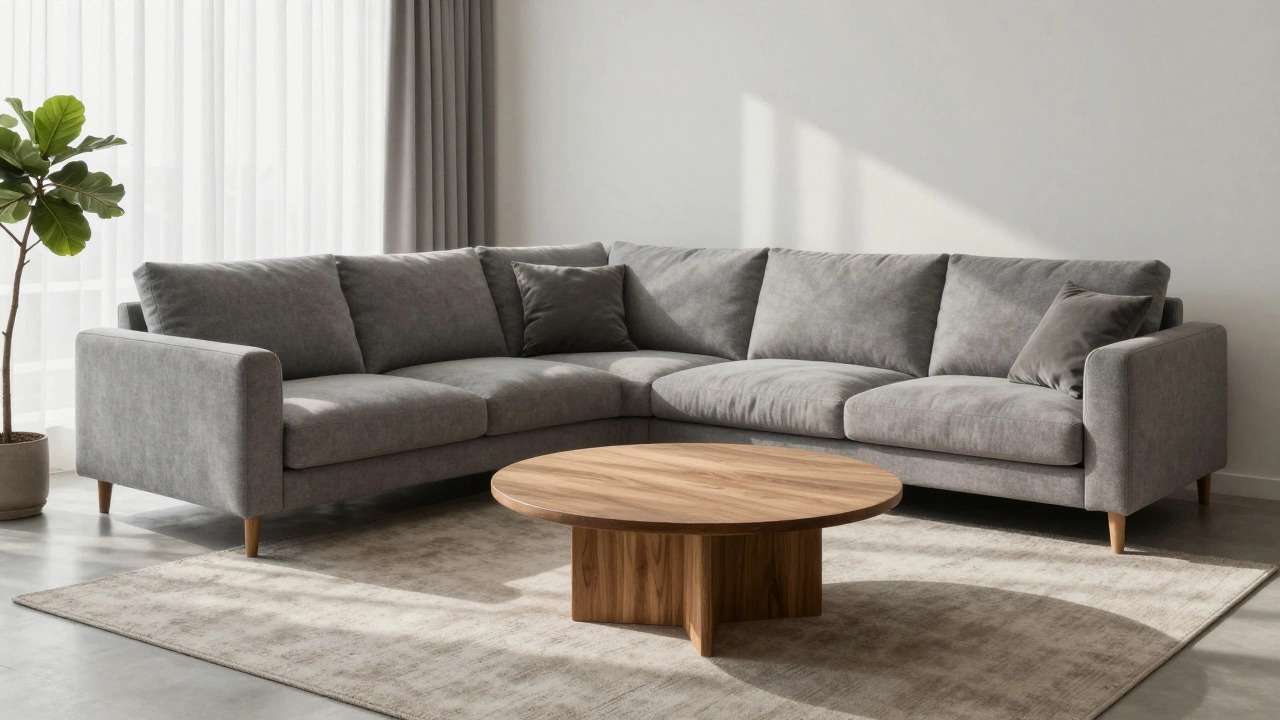
A coffee table is often treated as the final decorative piece in a living room.
People choose the sofa first, then the rug, then perhaps the TV wall or shelving, and the coffee table is added at the end because the room feels incomplete without one.
But in a well-designed living room, the coffee table is not an afterthought. It is the piece that connects the seating area.
It decides how easy it is to reach a drink, place a book, style a tray, move around the sofa, or make the room feel balanced from the center outward.
This is why coffee table design is less about choosing the prettiest shape and more about getting proportion, height, spacing, and material right.
A beautiful table can still feel wrong if it sits too far from the sofa, blocks movement, or feels too small for the scale of the seating.
When homeowners look for stylish coffee tables, the best choice is not always the most dramatic design.
It is the table that matches the sofa, fits the circulation space, supports daily use, and quietly strengthens the room’s layout.
A good coffee table should make the living room feel more finished without making it harder to live in.
Start With the Sofa, Not the Table
The coffee table should always be chosen in relation to the sofa. This is the first rule, and it solves many common mistakes.
A long sofa needs a table with enough length to feel visually connected. A compact loveseat needs something lighter.
A deep sectional may need a larger surface or nesting tables that can serve multiple seats.
A reclining sofa may need more clearance than a standard sofa. A sofa with a chaise may work better with a round or oval table because those shapes soften the corner.
The mistake is to choose a coffee table as if it exists on its own.
In reality, the table belongs to a seating system.
Look at the sofa’s width, seat height, arm shape, and visual weight.
A heavy sofa with deep cushions can usually handle a more substantial table.
A slim, low-profile sofa may look better with a lighter table. If the sofa has rounded edges, a curved table may feel more natural.
If the sofa is structured and angular, a clean rectangular or square table may make more sense.
The table should not compete with the sofa. It should complete it.
The Right Coffee Table Height
Height is one of the easiest details to get wrong.
A coffee table that is too high can feel awkward and bulky.
A table that is too low may look stylish in photos but become inconvenient in daily use.
The ideal height usually sits close to the sofa seat height, either level with the seat or slightly lower.
This matters because coffee tables are practical.
People reach for drinks, remote controls, books, snacks, candles, and trays. If the table is too low, every reach becomes slightly uncomfortable.
If it is too high, the seating area may feel visually blocked.
A simple rule is this: the coffee table should usually be within a few inches of the sofa seat height.
That does not mean every table must be perfectly level.
Some low sculptural tables work beautifully in minimalist rooms look, especially when the sofa is also low. But if the living room is used every day, function should not be sacrificed for a showroom look.
The best height feels natural when someone is seated.
Length and Width Matter More Than People Think
Many coffee tables are chosen too small.
They may look delicate, but they leave the sofa feeling disconnected. Others are too large and make the room feel crowded.
As a general guide, the coffee table should be about one-half to two-thirds the length of the sofa.
This creates a visual relationship without making the table dominate the seating area.
With sectionals, the rule becomes slightly more flexible.
A large L-shaped or U-shaped sectional may need a square, oval, or oversized rectangular table to reach more seats.
In some cases, two smaller tables or nesting tables work better than one large piece.
The width should also leave enough room for movement.
A coffee table that is too wide can make it difficult to walk between the sofa and the table, especially in apartments or narrow living rooms.
Here is a practical proportion guide:
| Sofa or seating type | Best coffee table direction | Design reason |
| Standard three-seat sofa | Rectangular or oval table | Follows the sofa length and keeps the layout balanced |
| Loveseat or compact sofa | Round, small oval, or nesting tables | Keeps the room light and easy to move through |
| L-shaped sectional | Round, oval, or large rectangular table | Softens the corner and serves both sides of the seating |
| U-shaped sectional | Square, large round, or paired tables | Reaches more seats and fills the central zone |
| Reclining sofa | Lightweight or movable table | Allows space for footrests and shifting positions |
| Sofa with chaise | Round or oval table | Avoids sharp corners near the chaise and improves flow |
Spacing: The Detail That Changes Everything
Even the right coffee table can feel wrong if the spacing is off.
If the table is too close to the sofa, people have to squeeze their legs in.
If it is too far away, it becomes decorative rather than useful.
Most living rooms work best when there is enough space to move comfortably between the sofa and the table while still keeping the surface within easy reach.
In smaller rooms, this spacing becomes especially important.
A large coffee table may technically fit, but if it interrupts the main walking path, the whole room will feel tight.
Think about how people move through the space.
Does the table block the route from the sofa to the hallway? Does it interfere with a sliding door or balcony? Does it make it hard to sit down? Can someone walk around it while another person is seated?
These questions are not glamorous, but they are what make a room comfortable.
A living room that looks good but feels awkward to move through is not well designed.
Shape Changes the Mood of the Room
Coffee table shape affects both function and atmosphere.
Rectangular tables are classic because they work well with standard sofas.
They create order and are easy to style with books, trays, and décor. They are often the safest choice in long rooms.
Round tables feel softer. They are especially helpful in small rooms, homes with children, or layouts where people move around the table often.
Without sharp corners, the room feels easier and more relaxed.
Oval tables offer a middle ground. They provide length like a rectangular table but feel gentler in circulation.
They are especially useful with sectionals or sofas with chaises.
Square tables work well with large seating arrangements, especially U-shaped sectionals or conversation-style layouts.
They create a strong central point, but they require enough space around them.
Nesting tables add flexibility.
They are useful in small homes, multifunctional rooms, and spaces where the table needs to expand or move depending on the day.
The right shape should match the way the room behaves.
A room with many straight lines may benefit from a curved table.
A room that already feels soft may need a more structured piece to ground it.
Material Should Match the Room’s Lifestyle
A coffee table sits at the center of daily living, so material choice matters.
Glass can make a small room feel lighter because it takes up less visual space. But it can show fingerprints and may not be ideal for households with young children.
Wood adds warmth and works in almost every style, from modern to rustic to transitional.
Stone feels refined and sculptural, but it can be heavy both visually and physically.
Metal frames can add structure without too much bulk.
Upholstered ottomans offer softness and can double as extra seating, but they may need trays for drinks.
The material should match the household’s habits.
A formal living room can handle a more delicate table.
A family room may need something durable and easy to clean.
A small apartment may benefit from lighter materials. A pet-friendly home may need rounded edges and stable construction.
A coffee table is not only looked at. It is touched, leaned on, moved around, and used every day.
Matching the Coffee Table to the Sofa Style
Sofa style should guide coffee table style, but the two do not need to match perfectly.
A modern low-profile sofa often works well with a clean wood, stone, or metal table.
A plush deep sofa may need a table with enough visual weight to balance it.
A curved sofa can look beautiful with a round or oval table.
A button-tufted sofa may pair well with a table that has classic lines, warm wood, or a more refined finish.
The key is contrast with connection.
If everything is too similar, the room can look flat.
If everything is too different, the room can feel accidental.
A soft fabric sofa may benefit from a harder table material such as wood or stone.
A structured leather sofa may feel warmer with a textured or rounded table.
The coffee table should create a conversation with the sofa.
It does not need to repeat the same shape, but it should understand the same design language.
Styling Without Clutter
Coffee table styling is where many rooms go from finished to crowded.
A styled coffee table should still leave space for real life.
There should be room for a drink, a book, a remote control, or a snack.
If every inch is covered with candles, vases, trays, and stacked books, the table becomes a display surface instead of a useful part of the living room.
A simple styling formula often works best:
- Start with one tray to group smaller items.
- Add one or two books for height and texture.
- Use one sculptural object or bowl.
- Add greenery or flowers if the room needs softness.
- Leave open space so the table can still be used.
The most natural coffee tables are not perfectly staged. They look considered but not untouchable.
Small Living Rooms Need Flexible Tables
In a small living room, the coffee table may need to do more with less.
A large solid table can make the room feel blocked. Instead, consider round tables, nesting tables, narrow rectangular tables, or storage tables with hidden compartments.
A table with open legs can also make the floor feel more visible, which helps the room feel larger.
Storage can be useful, but it should not make the table too bulky.
A coffee table with drawers or a lift-top surface may work well if the room lacks storage elsewhere.
In very tight spaces, a pair of small tables may be better than one central piece.
The best small-space coffee table is easy to live around. It should not turn every movement through the room into a negotiation.
Common Coffee Table Mistakes to Avoid
A coffee table can quietly weaken a living room if the proportions are wrong. The most common mistakes are easy to avoid:
- Choosing a table that is too high for the sofa.
- Choosing a table that is too small for a long sofa.
- Placing the table too far away to use comfortably.
- Using a heavy table in a room that already feels crowded.
- Forgetting to leave space for reclining seats or chaise lounges.
- Choosing sharp corners in a tight walkway.
- Styling the surface so heavily that it cannot be used.
- Ignoring the relationship between the table, rug, and sofa.
These details may seem minor, but they affect how the living room feels every day.
Good design is often the result of small measurements being right.
The Rug Also Matters
The coffee table rarely sits alone. It usually sits on a rug, and that rug changes how the table relates to the sofa.
If the rug is too small, the coffee table may look like it is floating.
If the rug is large enough to connect the front legs of the sofa and chairs, the seating area feels more grounded.
The coffee table then becomes part of a complete zone rather than a separate object in the middle.
The table should feel centered within the rug and seating arrangement, not just centered in the room.
This distinction matters in open-plan spaces where the living area may not align perfectly with the walls.
A rug defines the seating zone. The coffee table gives that zone a center.
Final Thoughts
A coffee table may be small compared with a sofa or entertainment center, but it has a large effect on how the living room works.
It influences proportion, movement, comfort, styling, and daily convenience.
The best coffee table is not chosen in isolation.
It is chosen in conversation with the sofa, rug, room size, traffic flow, and household habits.
When the height is right, the scale feels balanced, and the shape supports movement, the coffee table becomes more than a decorative surface.
It becomes the quiet center of the living room.
A well-matched coffee table does not demand attention.
It simply makes the whole seating area feel complete.