
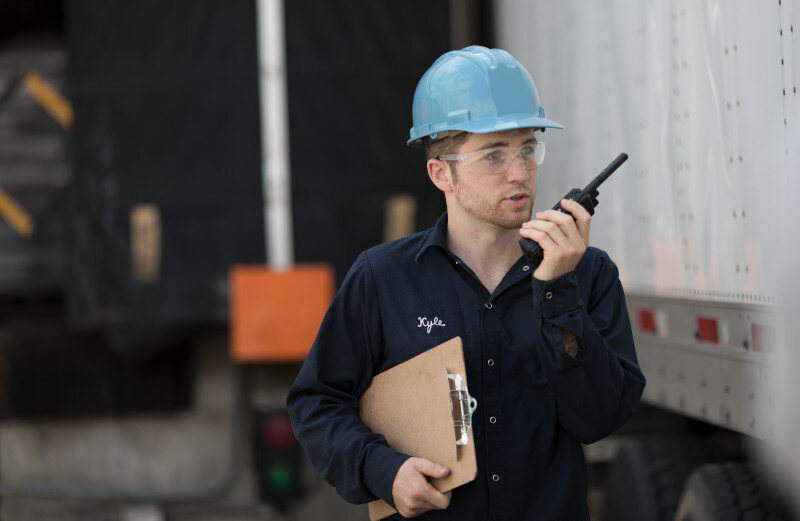
Construction sites are loud, unpredictable, fast-moving environments held together by deadlines, steel beams, caffeine, and communication that absolutely cannot fail.
That last part matters more than people outside the industry realize.
Because when crews are coordinating cranes, forklifts, concrete pours, deliveries, heavy machinery, electrical work, and safety protocols simultaneously, delayed communication stops being an inconvenience and starts becoming a liability.
Which raises an interesting question:
Why do so many construction teams still rely on two-way radios when smartphones exist?
Simple.
Smartphones are designed for convenience.
Two-way radios are designed for operational reliability.
And those are not the same thing.
Construction Sites Don’t Have Time for Communication Delays
A construction site moves in real time.
Supervisors coordinate subcontractors while materials arrive unexpectedly early. Equipment operators need immediate updates.
Safety teams respond to hazards instantly. Crews spread across multiple floors or large properties need constant coordination throughout the day.
Text messaging doesn’t work well in that environment.
Neither do missed calls.
Nobody operating heavy equipment wants to stop, unlock a phone, swipe through notifications, and search for a message buried beneath sports alerts and weather updates.
Construction communication needs to happen immediately.
That’s where two-way radios still dominate.
Push button. Speak. Message delivered instantly.
No friction. No delay. No unnecessary layers.
Simple systems survive because they reduce operational risk.
Smartphones Are Built for Distraction
This is probably the biggest difference nobody talks about enough.
Smartphones are multitasking machines.
That sounds impressive until you’re standing beside active machinery while your device vibrates with:
- Group chats
- App notifications
- Spam calls
- Software updates
- Social media alerts
- Calendar reminders
- Low battery warnings
- News headlines nobody urgently needed
Construction crews don’t need more distractions. They need faster coordination.
Two-way radios focus on one core function:
Reliable communication.
That focus becomes incredibly valuable in environments where situational awareness directly affects safety and productivity.
According to the Occupational Safety and Health Administration, effective communication remains a critical component of workplace safety in construction and industrial environments.
Delayed or unclear communication contributes significantly to operational hazards on active job sites.
And construction sites generate enough chaos already without adding communication confusion into the mix.
Durability Actually Matters on Job Sites
Consumer smartphones are fragile.
Everyone knows it. Everyone pretends otherwise until their phone lands face-down on concrete and suddenly becomes an abstract art installation made of shattered glass.
Construction environments are brutal on equipment.
Dust. Mud. Rain. Extreme temperatures. Vibration. Heavy impacts. Long shifts.
Constant handling. Devices clipped to belts while workers climb scaffolding or move materials across rough terrain.
Professional two-way radios are built for those conditions.
They prioritize:
- Rugged construction
- Long battery life
- Loud audio clarity
- Reliable push-to-talk functionality
- Fast access under pressure
Because communication devices on job sites need to survive real-world conditions, not ideal laboratory demonstrations performed by people wearing spotless gloves.
Battery Life Is a Bigger Deal Than People Admit
Modern smartphones drain battery life aggressively.
Navigation apps, background updates, notifications, streaming services, and constant connectivity eat through power quickly.
On long construction shifts, that becomes a real operational problem.
A dead communication device halfway through the workday creates unnecessary risk.
Two-way radios are built differently.
Since they prioritize communication over entertainment and multitasking, many deliver significantly longer operational battery life during demanding shifts.
That reliability matters when crews work:
- Extended hours
- Outdoor projects
- Multi-site operations
- Remote locations
- Emergency response situations
Nobody wants communication systems dependent on whether someone remembered to bring a charging cable.
Instant Group Communication Still Wins
Construction projects involve multiple teams operating simultaneously:
- Equipment operators
- Site supervisors
- Electricians
- Concrete crews
- Security personnel
- Delivery coordinators
- Safety managers
Two-way radios allow immediate group-wide communication without requiring multiple calls or fragmented message chains.
One transmission reaches the necessary team instantly.
That speed improves:
- Coordination
- Workflow efficiency
- Hazard response times
- Material logistics
- Emergency communication
And honestly, efficiency compounds quickly on large job sites.
Saving even small amounts of time repeatedly throughout the day can significantly affect overall project operations.
Consumers and businesses exploring professional communication systems for demanding work environments can learn more through resources focused on long-range push-to-talk reliability and operational coordination.
Construction Technology Keeps Evolving, But Reliability Still Matters Most
Construction sites use drones, digital blueprints, AI-assisted planning tools, and advanced machinery now.
Technology evolves constantly across the industry.
Yet two-way radios remain essential for one reason:
They solve a problem better than smartphones do in high-pressure environments.
Fast communication.
Minimal distraction.
Reliable coordination.
And honestly, on a construction site, that combination matters far more than flashy features ever will.