
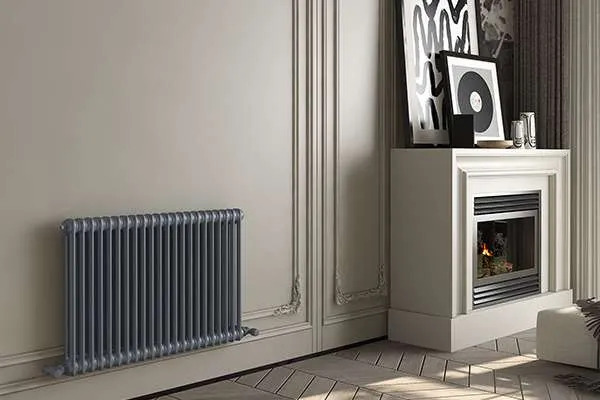
Most people, when they think about radiators, think white.
Horizontal. Tucked under a window. Functional, yes. Beautiful? Not exactly.
But grey changes things. Really does. Whether it’s a cool slate, a warm charcoal, or that deep anthracite that sits somewhere between grey and black — there’s a version of grey that fits almost any room you’re working with. And it doesn’t just “fit” in a neutral, inoffensive way.
It can genuinely add something to the space.
When it comes to integrating grey radiators into your home’s decor, the possibilities are truly endless.
That’s not an overstatement. I’ve been writing about home design for fifteen years now, and radiators — grey ones specifically — keep coming up as one of the most low-effort, high-impact changes people make.
You swap out a tired white panel for a considered grey column or flat panel, and suddenly the room looks like someone made deliberate choices in it. Because they did.
Below are 10 practical ways to pull that off — whether your interior is modern, traditional, or that comfortable middle ground most of us actually live in.
10 Ways To Incorporate Grey Radiators Into a Modern or Traditional Interior
Not every tip here will apply to your space.
Some might feel obvious once you read them. Others might shift how you’re thinking about a room you’ve been stuck on for months.
Either way, these are grounded in how grey radiators actually behave in real interiors — the BTU considerations, the material choices, the valve details that most guides skip entirely.
Match Grey Radiators with Neutral Color Palettes
Neutral interiors are everywhere right now. And I mean proper neutral — warm whites, creams, linen tones, stone, soft beige.
Not grey exactly, but close enough that a grey radiator sits inside the palette rather than against it.
This is where grey radiators genuinely shine.
A white radiator in a cream room just disappears. It blends in but doesn’t add anything.
A grey radiator in the same room does something more interesting — it creates enough contrast to register as a design element without disrupting the quiet, restful feel of the space.
The key is tone matching. Warm neutral walls — sandy, biscuity, taupe-leaning — need a grey with warmth in it. Something with a brown undertone.
A cool steel grey will fight with warm plaster tones and look off.
Flip it around: crisp white walls work best with a cooler, cleaner grey. That slight contrast between the white of the wall and the cool grey of the radiator is sharp in a way that feels very current.
I’ve seen rooms transformed by one single swap.
Same walls, same furniture, same floor. Just a grey flat-panel radiator where the old white convector used to be.
The room suddenly had intention behind it.
Use Anthracite Grey Radiators as Statement Pieces
Anthracite doesn’t play it safe. That deep, near-black tone is confident, and that confidence translates directly into a room.
If you’ve got a wall that needs something — a hallway, a landing, an alcove beside a doorway — a tall anthracite column radiator becomes the focal point.
Not because it shouts, but because it has visual weight. It holds the space.
Think of it the same way you’d think about a piece of furniture or a piece of art: something that anchors a corner of a room and gives the eye somewhere to rest.
James from Plumber Parts makes exactly this point when talking about that hexagonal feature radiator — his plan was to mount it directly opposite the front door so it was the first thing anyone walking in would see.
That’s not a heating decision. That’s an interior design decision. The radiator becomes the room’s opening statement.
Anthracite works particularly well against softer, lighter walls. White or off-white backdrops let the radiator read clearly without competition.
Pair it with brass, black, or brushed nickel fixtures and you’ve got a material palette that feels considered without being overdone.
Blend Grey Radiators into Traditional Interiors
Here’s where a lot of people get stuck. Traditional interiors — Victorian terraces, Edwardian semis, Georgian townhouses — have character built into them.
Cornicing, deep skirting, original fireplaces. And there’s always a worry that a modern-looking radiator is going to undercut all of that character.
Traditional column radiators in grey fix this almost entirely.
Those round tube sections, the height, the weight of the thing — they carry a period quality.
Not Victorian exact, but sympathetic to it. They don’t scream “installed recently.” They settle into the room like they were always there.
And here’s something I find genuinely interesting about grey in period homes: it often works better than white.
White can feel clinical against old lime plaster, exposed brick, or heritage paint colours.
A warm grey — something with depth and warmth to it — reads more settled. More like the house chose it.
Deep greens, navy, oxblood, terracotta — all the colours you see in traditional interiors — sit next to grey comfortably. Grey doesn’t compete with them.
It gives them room to breathe.
Coordinate Grey Radiators with Modern Furniture
Modern furniture tends to run through a palette of blacks, whites, greys, and natural woods.
Which is actually quite close to a radiator manufacturer’s colour range, if you think about it.
A horizontal grey flat-panel radiator underneath a window, in a room with pale wood floors and darker grey furniture, doesn’t stick out.
It becomes part of the material story. Same visual language, different product category.
One thing worth knowing: don’t try to match your grey radiator exactly to your sofa colour or furniture tone. Perfect matches look accidental.
A slight tonal difference — radiator a touch darker or cooler than the furniture — reads as more deliberate, more designed.
Modern rooms also tend to work with contrast, which is where anthracite earns its keep.
Against white walls and light wood, a dark grey radiator reads as a conscious decision. Confident. Not aggressive.
And the valves — this one matters more than people expect.
Grey TRVs and lock shields are available in anthracite and matching grey finishes.
A sleek, considered valve alongside a designer grey radiator keeps the whole installation looking joined up.
One standard white plastic TRV can quietly undo everything else you’ve done in that room.
Install Vertical Grey Radiators to Save Space
Practical and good-looking. Not always the same thing, but with vertical radiators, usually both apply at once.
The logic is clean: if you don’t have much wall space horizontally, go vertical.
Most UK homes have narrow stretches of wall beside doors, windows, or in hallways that sit there doing nothing.
A vertical radiator uses that space productively. You’re going up rather than across.
What surprises people is that you don’t have to sacrifice heat output for height.
A well-specified vertical radiator can put out the same BTU as a wider horizontal one.
You just need to run the numbers — BTU calculators are freely available online, and the calculation itself takes about five minutes once you’ve got your room dimensions and window details to hand.
In grey, vertical radiators feel modern almost by default.
The height draws the eye upward, which visually lifts the ceiling. In a low-ceilinged kitchen or a narrow hall, that matters.
The room reads bigger. Less compressed. And a slim grey vertical radiator in a space like that stops the area feeling like an afterthought.
Pair Grey Radiators with Natural Materials
Wood. Stone. Exposed brick. Linen. Raw concrete.
These materials are central to how a lot of people are designing homes right now — and they sit alongside grey radiators more naturally than any other radiator colour.
White radiators can look forced against raw brick or reclaimed timber.
The bright white reads too processed, too clean, against those uneven textures.
Grey fits that space without friction. It feels like it grew alongside the material rather than being dropped in later.
Warm-toned wood floors — medium oak, walnut — pair comfortably with a mid-grey radiator.
The warmth of the wood and the relative coolness of the grey create a balance that feels intentional rather than jarring.
Paler floors, lighter ash or birch, suit a slightly warmer grey for similar reasons.
You want the tones to relate rather than compete.
Stone fireplaces, slate flooring, raw concrete panels — anthracite is almost the obvious choice in these settings.
The radiator picks up the tonal quality of the natural material and ties the room together. No effort required.
Use Grey Radiators in Kitchens and Bathrooms
Kitchens and bathrooms are full of hard, reflective surfaces — tiles, steel, chrome, stone. And grey works with all of them in a way that white often doesn’t.
White radiators in kitchens age poorly.
They pick up a yellowing quality over time, they look grubby next to stainless steel appliances, and they feel like a default rather than a decision.
Grey holds its appearance better and, more importantly, reads as intentional from the start.
James from Plumber Parts talks about exactly this — choosing a grey vertical radiator for his own kitchen, matching the worktops and the fridge, fitting into a narrow section of wall, and putting out over 6,000 BTU in a space with three external walls and substantial bifold glazing. That’s the real-world version of this.
Practical problem, considered solution, and the room looks better for it.
In bathrooms, grey column radiators or towel rails bring a calm, settled quality to the space. Not staged-magazine calm — just genuinely comfortable.
If you’re installing a bathroom radiator, one thing to bear in mind: over-spec the BTU by at least a quarter.
Bathroom heat loss is always higher than the calculation suggests.
Doors get left open. Tiled walls pull warmth from the air. Build in the buffer.
Complement Different Interior Design Styles
Grey doesn’t belong to a single interior style. That’s actually what makes it so broadly useful.
Industrial loft with exposed pipework and steel beams? Anthracite sits in that setting as if it was always part of the plan.
Scandi-minimal apartment with white walls and birch furniture? A cool mid-grey radiator reads quietly — present, not loud, not trying too hard.
Arts and Crafts interior with decorative tiles and rich patterned wallpaper? A warm grey column radiator grounds the space without fighting everything else that’s happening on the walls.
The finish matters here as much as the colour tone itself.
Matte anthracite is contemporary and reads seriously.
Gloss dark grey leans traditional, more decorative.
Satin sits between them comfortably. Before settling on a shade, look at the other finishes already in the room — door handles, taps, light fittings, mirror frames — and match to those rather than just the wall colour.
A matte grey radiator in a room full of gloss finishes will feel slightly wrong even if the colour itself is correct.
Finish consistency is what makes a room feel resolved.
Accessorize Around Grey Radiators
Radiator accessories don’t get nearly enough attention. They should.
A shelf mounted above a horizontal grey radiator gives you a useful surface — plants, books, objects — and frames the radiator as a deliberate design feature rather than a wall-mounted appliance you’re working around.
Some manufacturers produce shelves and brackets that match the radiator finish exactly.
Worth tracking those down rather than just grabbing a generic white shelf from a hardware store.
Towel rail attachments exist for most vertical radiators — small hooks and hangers in matching grey or anthracite finishes.
Subtle, practical, and they keep the material language consistent across the whole wall area.
As James mentions in discussing his kitchen installation, these accessories are available directly from the radiator supplier and are worth adding at the time of purchase rather than trying to retrofit later.
And once more, the valves.
A grey radiator with matching anthracite TRVs and lock shields looks complete — like someone thought it through to the end.
The same radiator with mismatched white plastic valves looks unfinished.
The difference between a room that looks “done” and one that looks “almost done” is often just that detail.
Choose the Right Shade and Finish for Your Home
Grey is not one colour. Worth saying clearly, because people sometimes treat it that way and end up with a radiator that fights the room rather than sitting inside it.
Anthracite is deep, almost black. Mid-grey is softer, more versatile, more forgiving in a wider range of rooms.
Cool greys pull towards blue.
Warm greys pull towards taupe or beige. Each reads differently on a wall, in different light, next to different materials.
The same anthracite radiator can look completely different in a north-facing room versus a south-facing one.
Beyond colour, the material of the radiator changes how it actually performs.
Steel radiators have a slow heat curve — they take longer to get hot, but they hold heat for a long time after the system turns off, which suits rooms where you want sustained background warmth.
Aluminium heats fast and cools fast — better for spaces where you’re managing temperature more actively, or where the wall fixings need a lighter load.
North-facing rooms with flat, cool light need warmer greys to avoid reading cold in winter.
South-facing rooms can handle cooler, cleaner tones without the space feeling sterile.
It’s a small thing, but once you’ve noticed it you can’t stop noticing it.
Stand in the room. Look at the light at different times of day. Then choose.
Conclusion
Grey radiators are one of the rare home decisions where the practical side and the aesthetic side line up properly.
The right one — right shade, right finish, sized correctly for the room — doesn’t just heat the space. It becomes part of how the room feels.
Something you’d actually notice if it wasn’t there.
A radiator that does its job silently while also looking like a deliberate design decision? That’s the whole point.
Start with the room, work out the BTU output you need, find the grey that fits the palette you’ve built, and don’t forget to sort the valves.
Get those four things right and you won’t be thinking about that radiator again — except to appreciate it.