
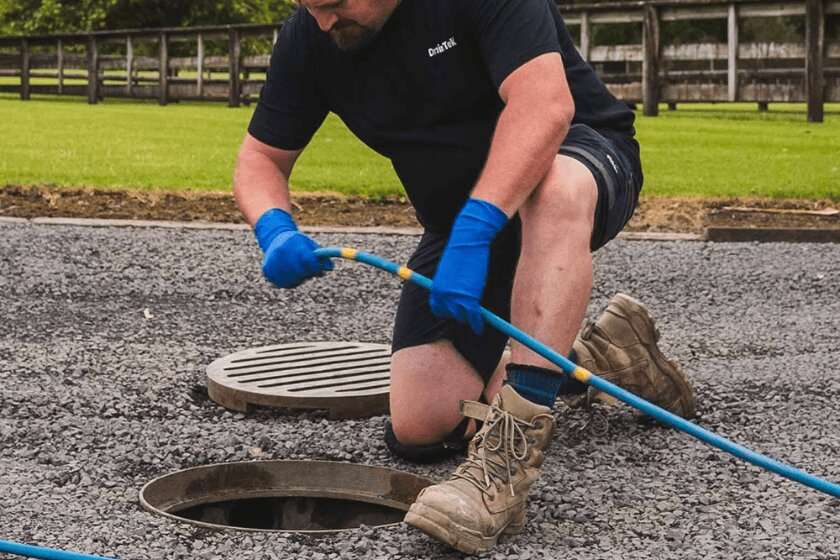
So you’re standing there looking at your stormwater drain, and everything seems fine.
The grate’s clear, there’s no leaves piled up, and you even poked around with a stick just to be sure. But when the rain hits, water’s pooling up in your yard, backing up near the foundation, or worse—creeping toward the house.
Here’s the thing: what you see at the surface doesn’t tell you squat about what’s happening six feet down in the pipe.
I’ve seen this play out dozens of times.
Homeowner calls, says the drain’s not working, insists they’ve checked it. And they’re not wrong—they did check it.
They just checked the only part they could see, which is usually the least helpful part.
The real problem? It’s lurking somewhere you can’t eyeball from ground level.
Why a Stormwater Drain Can Look Clear but Still Be Blocked
Stormwater drains don’t work like a sink.
When you look down into a sink drain, you’re basically seeing the start of the problem zone. But stormwater systems run underground, sometimes for dozens of meters, connecting pits, bends, junctions, and outlet points.
That little grate you’re staring at is just the entry.
Everything else is hidden.
Water doesn’t care if the top looks good.
It cares whether it can travel the full distance from your yard to wherever that pipe dumps out—usually a street drain, a kerb outlet, or a soakage trench.
If there’s a restriction anywhere along that route, the whole system backs up.
And here’s the kicker: blockages almost never happen right at the grate.
They happen where the pipe bends, where tree roots sneak in, where sediment settles after years of runoff, or where the pipe has started to collapse.
You won’t see any of that standing on your lawn.
Adelaide blocked drain plumbers often find that the most serious blockage is not visible at all.
The top of the pit may be clear, while a bend, junction, or section further along the line is holding back water.
This is why repeat flooding needs more than a quick surface clean.
Common Causes of Hidden Stormwater Drain Blockages
Let’s talk about what’s actually clogging up your system when you’re not looking.
Tree roots. This is the big one. Roots grow toward moisture, and your stormwater pipe is basically a water highway.
Even if the pipe’s PVC, roots can get in through joints, cracks, or anywhere the seal’s worn down.
Once they’re in, they spread out like a net, catching debris and forming a solid plug.
You might not even have a tree close to the drain. Roots travel.
Sediment buildup. Every time it rains, a little bit of dirt, sand, and silt washes into the system.
Over the years, that stuff settles in low spots or where the pipe has a slight belly.
Eventually, it builds up enough to slow the flow, then stop it completely.
This is common in older systems where the ground’s shifted or where the pipe wasn’t laid with proper fall.
Broken or collapsed pipe. Pipes crack. They shift.
They get crushed by vehicles, tree roots, or just age.
When a section collapses, even partially, it creates a dam. Water can’t get past, so it backs up. From the surface, you’d never know.
Incorrect or damaged pipe joins. If the sections of pipe weren’t joined properly during installation, or if they’ve separated over time, you get misalignment.
Water hits that step or gap and slows down. Debris catches. Blockage forms.
Foreign objects. Kids’ toys, builder’s rubble, chunks of concrete, old bricks—I’ve pulled all kinds of junk out of stormwater drains.
Sometimes it’s been there since the house was built.
Signs Your Stormwater Drain Is Blocked Underneath
You don’t need a camera to know something’s wrong. The system tells you.
Water pooling after rain. If your yard turns into a swamp every time it rains, even light rain, that’s your first clue.
Water should drain within an hour or two. If it’s sitting there for half a day, the system’s not doing its job.
Slow drainage from downpipes. You ever notice water trickling out of a downpipe long after the rain stopped? That’s because it can’t get away fast enough.
There’s a restriction somewhere downstream.
Gurgling sounds. If you hear weird noises coming from the drain when water’s running in, that’s air trying to escape around a blockage. It’s the drain equivalent of a clogged toilet.
Overflow at the pit. Water coming up out of the stormwater pit during heavy rain is a dead giveaway.
The water’s got nowhere else to go, so it backs up and spills out the top.
Smelly or stagnant water. If there’s standing water in the pit that doesn’t drain between storms, and it starts to stink, you’ve got a blockage holding water in the line.
How Professionals Detect an Underground Blockage
So how do plumbers figure out where the clog is when they can’t see it?
Drain camera inspection. This is the go-to.
A small waterproof camera gets fed down the pipe, sending back live video. You can see cracks, roots, sediment, collapses—everything.
Most cameras have a locator beacon, so the plumber knows exactly how deep and where the problem is, even if it’s under a driveway.
Water testing. Sometimes a plumber will pour water down different access points and watch where it goes.
If it backs up at one pit but not another, that narrows down the section where the blockage is.
Listening and probing. Older-school method, but still works.
Tap along the pipe route, listen for changes in sound, feel for soft spots in the ground.
Not as precise, but it can point you in the right direction.
Smoke testing. For systems with multiple connection points, smoke can be pushed through to find cracks or illegal connections.
You’ll see smoke coming up where it shouldn’t.
How to Clear a Stormwater Drain Properly
If you’re handy and the blockage is minor, you might be able to clear it yourself.
Emphasis on might.
Start at the pit. Pull the grate off and scoop out any visible debris—leaves, mud, sticks.
Use a garden trowel or your hands if you’re not squeamish. Sometimes that’s all it takes.
Flush with a hose. Stick a hose down the outlet pipe and turn it on full blast.
If the blockage is loose, the pressure might push it through. Watch the water level.
If it starts backing up, stop. You’re just making it worse.
Use a drain snake or rod. You can buy a basic hand-crank snake or plumber’s rod from hardware stores. Feed it into the pipe and work it back and forth.
If you hit something solid, try to break it up or hook it out. Be gentle—you don’t want to crack the pipe.
Try a wet/dry vac. If the blockage is near the pit, a shop vac might suck it out.
Seal the hose as best you can around the pipe opening and let it rip.
But here’s the reality: if the blockage is deep, caused by roots, or involves a broken pipe, you’re not fixing it with a hose and a stick.
You’ll need a high-pressure water jetter, professional rodding equipment, or even excavation.
Calling someone who knows what they’re doing isn’t giving up. It’s just smart.
How to Prevent Hidden Stormwater Drain Blockages
You can’t stop every blockage, but you can make them way less likely.
Keep grates clear. Sounds obvious, but do it.
After every storm, pull off the grate and clear out leaves, dirt, and debris. Takes five minutes.
Trim back trees and shrubs. If you’ve got plants near your stormwater line, keep them pruned.
Roots follow water, so the less temptation, the better.
If you’re planting new trees, keep them well away from drains.
Install a leaf guard or mesh screen. These sit over or inside the pit and catch debris before it gets into the pipe.
You’ll still need to clean them, but it beats digging up your yard.
Get the system inspected every few years.
A camera inspection every three to five years can catch problems early—before they turn into full blockages. It’s cheap insurance.
Fix issues fast. Notice a slow drain? Don’t wait. Small blockages turn into big ones.
Cracks let in roots. A little attention now saves a lot of money later.
Check after big storms. Heavy rain can wash a ton of debris into your system.
Give it a quick check afterward, even if it seems fine.
When to Call a Drainage Professional
Some jobs are DIY-friendly. Others aren’t.
Call a professional if:
- Water’s still pooling after you’ve cleared the visible stuff
- You’ve tried flushing and snaking, and nothing’s changed
- You hear gurgling or see overflow during rain
- There’s a foul smell coming from the drain
- You suspect tree roots or a broken pipe
- The system’s old and you’ve never had it inspected
Professionals have equipment you don’t: high-pressure jetters that can blast through roots and sediment, cameras that show exactly what’s wrong, and locators that pinpoint the problem without guessing.
They also know how to dig up and replace sections of pipe without wrecking your yard.
If you’re in an area with older infrastructure or lots of trees, a one-off inspection is worth it.
You’ll either get peace of mind or a clear action plan. Either way, you’re ahead.
Conclusion
So yeah, your drain looks fine from the top. But that doesn’t mean much when the real trouble is ten feet down in a pipe you can’t see.
Stormwater systems hide their problems well, and by the time you notice something’s wrong, it’s usually been brewing for a while.
The good news? Once you know what to look for and how the system actually works, you can stay ahead of it.
Clear the grates, watch for slow drainage, and don’t ignore the warning signs. And when in doubt, get someone with a camera to take a look.
Because the worst blockage is always the one you didn’t know was there.