
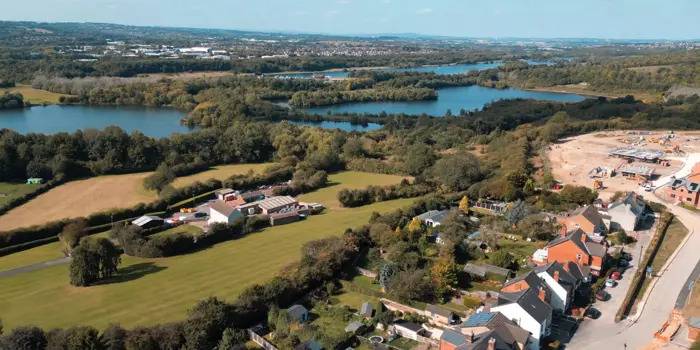
Nobody notices how much a neighborhood affects daily life until they spend twenty minutes looking for parking, sit through another traffic bottleneck, or realize the nearest grocery store is farther away than they thought.
People often focus on the house first, which makes sense, but many of the things that shape everyday comfort have little to do with the walls, flooring, or kitchen layout.
They come from the community around the home, and how that community was planned from the beginning.
Looking Beyond the House Itself
A home is where people sleep, eat, work, and spend time with family.
Still, daily life extends beyond the front door.
The route to school, access to parks, the amount of traffic on local streets, and even the way neighbors interact all influence how comfortable a place feels over time.
This is why thoughtfully planned communities continue to attract buyers.
These neighborhoods are usually designed with long-term living in mind rather than simply fitting as many houses as possible onto a piece of land.
Roads, public spaces, walking paths, and amenities are often considered together, creating a more balanced environment.
In many cases, residents do not immediately notice the planning.
They simply notice that things work better. School drop-offs feel less stressful.
Evening walks become easier. Errands require less driving. Small improvements like these add up over the years.
Why Communities Reflect a Growing Trend
Many newer residential developments are being designed around the idea that people want more than a house and a street address.
They want access to shared spaces, outdoor recreation, and neighborhoods that encourage interaction without feeling crowded.
Developers have started paying closer attention to how residents actually live rather than focusing only on square footage and lot sizes.
For this reason, communities like La Segarra are getting so popular.
The emphasis is not only on homes themselves but also on green spaces, trails, gathering areas, and a layout that supports everyday convenience.
It represents a broader shift toward neighborhoods that are planned as complete living environments rather than collections of individual properties.
Better Use of Space
One of the biggest advantages of a thoughtfully planned community is how space is organized.
Older neighborhoods sometimes developed in stages over many years.
As a result, roads may feel disconnected, public areas may be limited, and access to services can become uneven.
Newer planned developments often take a more coordinated approach from the start.
Parks are placed where residents can actually reach them.
Walking paths connect different sections of the neighborhood. Community features are distributed in ways that serve the largest number of people.
These decisions may sound minor, but they have a noticeable impact on daily routines.
People often assume convenience comes from living closer to a city center. In reality, convenience frequently comes from thoughtful design.
Stronger Sense of Community
The phrase “sense of community” gets used a lot, sometimes too much, but there is a practical side to it.
When neighborhoods include shared spaces, residents naturally encounter one another more often. Children play in common areas.
Neighbors meet during walks. Local events become easier to organize.
None of this guarantees friendships, of course, but it creates opportunities for connection.
This matters more than many people realize.
Remote work has changed how people spend their time.
More individuals now work from home at least part of the week.
As a result, neighborhood relationships have become more important than they were for many households a decade ago.
A well-planned community helps support those connections without forcing them.
Access to Outdoor Amenities
Over the last few years, buyers have shown greater interest in outdoor living. That trend continues today.
People want places to walk, run, exercise, or simply spend time outside without having to drive across town.
Communities that include trails, green areas, playgrounds, and open spaces tend to provide these opportunities more naturally.
There is also a practical side. Homes located near desirable recreational features often remain attractive to future buyers.
Market conditions change, but access to quality outdoor amenities tends to hold value because the demand remains fairly consistent.
Improved Traffic Flow and Safety
Traffic frustrations affect quality of life more than most people expect.
Poorly planned neighborhoods can create congestion at key intersections, especially during school and work commuting hours.
Newer developments often address these issues during the planning stage by considering traffic patterns, road widths, and access points before construction begins.
The result is not perfect traffic, because no neighborhood can completely avoid growth-related challenges.
Still, better planning can reduce some of the daily friction that residents experience.
Safety benefits may also emerge from thoughtful layouts.
Better visibility, pedestrian pathways, and clearly defined public areas can contribute to a more comfortable environment for residents.
Long-Term Property Appeal
Homebuyers often think about current needs, which is understandable.
They need enough bedrooms, a workable budget, and a location that fits their routine.
At the same time, future appeal matters. People move for many reasons. Job changes happen. Families grow. Retirement plans shift.
A property that sits within a desirable, well-maintained community may attract a broader range of future buyers when it is time to sell.
This does not mean every home will automatically increase in value.
Real estate markets rarely work that neatly.
However, communities with strong infrastructure, maintained amenities, and thoughtful design often remain competitive over longer periods.
A More Predictable Living Experience
One benefit that receives less attention is predictability.
When communities are carefully planned, residents generally have a clearer understanding of what the neighborhood will become over time.
Future amenities, development phases, and public spaces are often outlined early in the process.
That does not eliminate surprises. Development projects can evolve.
Economic conditions can shift. Still, having a long-term vision tends to reduce uncertainty compared with neighborhoods where growth occurs in a less coordinated manner.
For many homeowners, that predictability creates confidence in their decision.
Choosing the Right Environment
Finding the right home involves more than comparing floor plans or counting bathroom fixtures.
The surrounding environment shapes daily experiences in ways that become clearer after moving in.
Thoughtfully planned communities attempt to address those experiences before residents arrive.
They consider movement, access, recreation, and shared spaces as parts of a larger system.
Some elements work quietly in the background, which is often the point.